

The issuance of Regulation of the Minister of Agriculture (MOA) No. 15 of 2025 opens up both opportunities and challenges in the distribution of subsidized fertilizers. This regulation has sparked attention. Three professors from IPB University shared their perspectives.
One of the highlights is the expansion of subsidized fertilizer distributors. In the MOA, distribution is not only by retail kiosks, but can now also be done by farmer group associations (gapoktan), fish farmer groups (pokdakan), and cooperatives.
In response to this, Professor of the Faculty of Economics and Management (FEM) IPB University, Prof Yusman Syaukat, emphasized the need for managerial readiness, clarity of kiosk profit margins, and simplification of the subsidy system so that it is right on target.
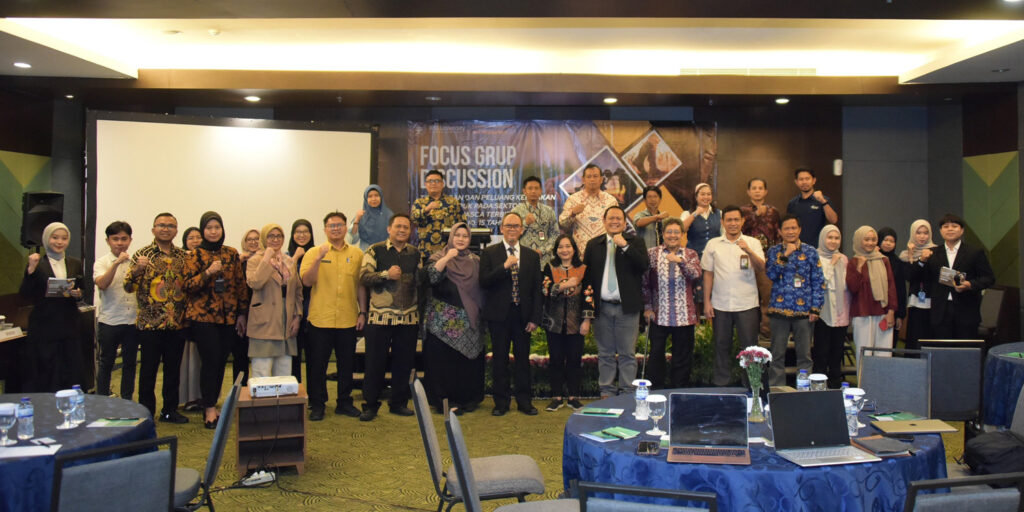
“The addition of distributors must be accompanied by the development of managerial, financial, and administrative capabilities,” he said in a Forum Group Discussion related to MOA No. 15 of 2025 at the IPB International Convention Center, Bogor (6/17).
The Chairman of the Senate of FEM IPB University also warned that if not handled properly, this policy could harm existing distributors and cause non-compliance with applicable regulations. “This could be a disincentive for existing distributors and have a negative impact on farmers receiving fertilizer,” he said.
Besides, the addition of cooperatives as subsidized distributors is in line with the Merah Putih Cooperative program. For information, the government is targeting the launch of 80.000 Merah Putih Cooperatives in all villages and sub-districts starting July 2025.
On the other hand, a study conducted by Prof A Faroby Falatehan, revealed that there are differences in the cost of production (HPP) of fertilizers and reference production prices between one place and another.
As a Professor of Agricultural Economic Policy, Prof Faroby considers that government policies related to the highest retail price (HET) should consider a decent profit margin for kiosks.
“It should have been considered that the HET already has a margin. If now, with this subsidy (the income of kiosk operators) is less,” he added.
According to him, subsidies are indeed attractive. However, he suggested that it still needs to be reviewed from the aspect of margin feasibility. “Maybe the feasible margin standard is between 15-20 percent, so that it can be even more vibrant,” he said.
Prof Faroby said that fertilizer is indeed an important necessity for farmers, although the cost is only about 20 percent of the total production cost. However, it has a huge impact on plant growth.
“Farmers are not ‘confident’ if they don’t use fertilizer, so they have to buy it. However, if there is fertilizer at the kiosk, it will definitely sell,” he said.
Another viewpoint, Prof Hermanto Siregar, stated that fertilizer subsidies should not become a long-term dependency for farmers. There must be steps to keep farmers prosperous, but in the long run, their dependence on subsidies decreases.
In economic terms, he explained, subsidies often distort prices and are a source of inefficiency. Therefore, subsidies must be targeted and limited within a certain period of time. “If it is not targeted, then like in the past, it will continue to exist and the amount will definitely increase,” he said.
Prof Hermanto also suggested simplifying the subsidy system to reduce potential violations. “The more complex it is, the bigger the chains where violations may occur. If it can be simplified, it will be better,” he said.
The FGD was attended by the Director of Fertilizers and Pesticides of the Ministry of Agriculture, the Chairman of the Agricultural Extension Center of the Ministry of Agriculture, the Assistant Deputy for Supply Chain of the Deputy for Talent Development and Cooperative Competitiveness of the Ministry of Cooperatives, and the Executive Director of the Institute for Development of Economics and Finance (INDEF). (dr) (IAAS/KQA)
