

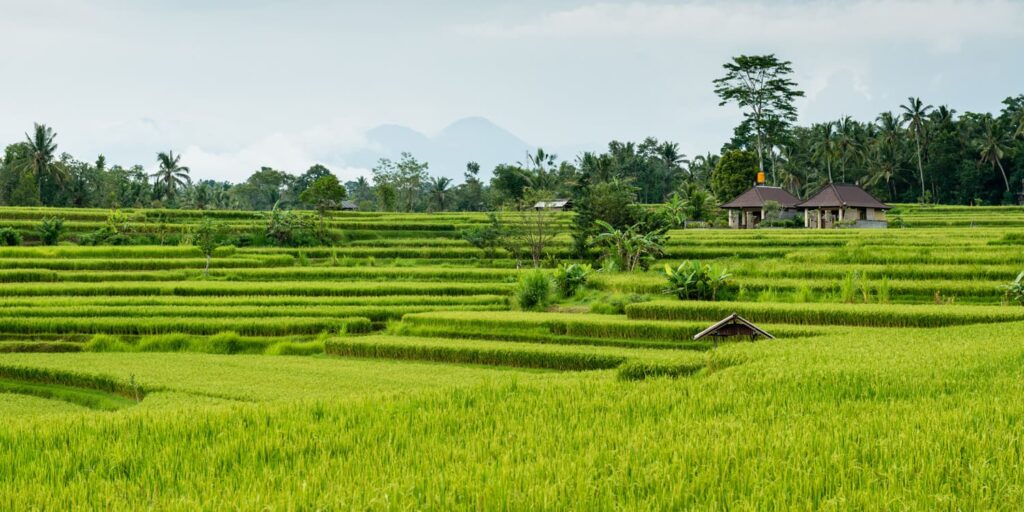
This year’s World Food Day on October 16 once again emphasizes how crucial agricultural land is for Indonesia’s food future. On this occasion, two IPB University professors, Prof Suryo Wiyono and Prof Baba Barus, highlighted the increasingly alarming conversion of rice fields.
“Our rice field area is only around 7,3 million hectares. This figure is very small compared to other countries. Globally, Indonesia ranks 130th out of 180 countries in terms of agricultural land availability per capita,” explained Prof Suryo.
According to data from the Ministry of Agriculture and the Central Statistics Agency (BPS), the area of rice fields decreased from 8,1 million hectares (2015) to 7,4 million hectares (2019). Land conversion continues to occur at a rate of 60.000–80.000 hectares per year, even reaching 96.512 hectares per year (2000–2015).
“If conversion reaches 100.000 hectares per year, in 10 years we will lose one million hectares. That would have a tremendous impact on national food security,” emphasized Prof Suryo, who is also Dean of the Faculty of Agriculture at IPB University.
Similarly, Prof Baba Barus, Professor at the Faculty of Agriculture at IPB University, added that formal protection for rice fields is still very weak.
“Currently, around three million hectares of rice fields in Indonesia are not yet categorized as formally protected land. If protection is not strong, rice field conversion can occur rapidly,” he said.
He explained that although Law 41/2009 on Sustainable Food Agricultural Land already exists, its implementation at the regional level remains weak. Many regional regulations (perda) are created without clear spatial maps, so land protection is not effective. As a result, 23 provinces are now experiencing a rice field deficit, while only 14 provinces have a surplus.
Prof Suryo emphasized that conversion occurs mostly in fertile areas such as Java, Sumatra, and Bali due to economic pressures. “One square meter of land can be worth billions of rupiah for housing or industry, while the rice harvest is not comparable,” he explained.
Meanwhile, Prof Baba highlighted that the food issue is not only about availability, but also distribution and access. “In terms of global figures, Indonesia does not seem to be lacking in rice. However, the issues of distribution and people’s purchasing power remain a challenge,” he said.
As a solution, Prof Suryo emphasized three strategies: protecting fertile land, opening up new agricultural areas, and increasing productivity. He also encouraged diversification through high-value crops such as edible mushrooms, horticulture, and spices.
Prof Baba added the importance of consistency in rice field protection policies and a fair transition for farmers. He emphasized the need to consider factors such as water, productivity, and farmers’ dependence on land.
The momentum of World Food Day and National Farmers’ Day serves as a reminder that land conversion is not merely a technical issue, but a strategic national concern. Without serious commitment from local governments, communities, and all stakeholders, the threat of a food crisis will become increasingly real.
“Farmers must prosper so that our food supply is guaranteed,” concluded Prof Suryo. (*/Rz) (IAAS/Ard)
