

In the midst of challenges such as climate change, land limitations, and a shift in food consumption patterns that are increasingly dependent on imported wheat based flour, Indonesia is required to present adaptive agricultural innovations.
IPB University offers a solution through plant breeding for lands under abiotic stress, as conveyed by the Professor of the Faculty of Agriculture at IPB University, Prof Trikoesoemaningtyas.
“Out of Indonesia’s total 189,1 million hectares of land, approximately 91,1 million hectares are suboptimal lands. This is the future space for our food production,” she explained during her Scientific Oration as an IPB University Professor on Saturday (2/14).
She explained that most of these lands face abiotic stresses such as low soil pH, salinity, and nutrient deficiencies. These conditions cause disrupted plant growth and low productivity.
“Therefore, we propose improving the adaptation of the crops. Breeding for stressful environments aims to increase yield stability under less-than-optimal conditions,” she stated.
Through physiological approaches and genetic analysis, she and the IPB University research team identified adaptation mechanisms and inherited tolerant traits. Precise selection characters were then developed to accelerate genetic progress and produce varieties that are more efficient and adaptive.
She detailed that this breeding program is based on three main pillars: resilience, sustainability, and humanity. “The resulting varieties must be adaptive, efficient in input use, and capable of improving farmers’ welfare,” she said.
Sorghum and Tropical Wheat
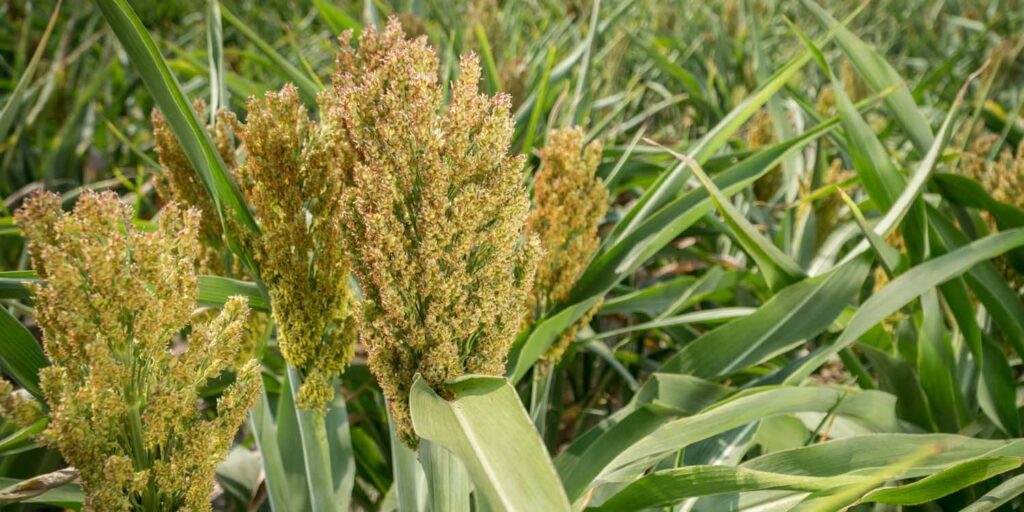
One of the commodities developed by Prof Trikoesoemaningtyas is sorghum. As the fifth largest food crop in the world, it has a protein content of around 11 percent, which is close to that of wheat.
“Sorghum can be easily processed into flour and is nutritionally competitive. It is even gluten-free, making it suitable for people with gluten intolerance,” she explained.
Furthermore, she added that besides being an alternative food source, sorghum also has potential as a source of bioethanol and biomass energy. “Its adaptation to acidic soils opens up opportunities to increase productivity while reducing dependence on fertilizers and lime,” said Prof Trikoesoemaningtyas.
In the context of dependence on wheat imports, which reached 12,7 million tons in 2024, IPB University is also developing tropical wheat through physiological, genetic, and shuttle breeding methods. Two varieties have been released in collaboration with the Wheat Research Consortium, namely Guri-7-Agritan and Guri-8-Agritan, which are adaptive to tropical medium-altitude highlands.
“From a nutritional standpoint, the wheat bred by Indonesian researchers is feasible for processing into nutritious food. However, currently, production is not yet sufficient for large-scale needs,” she revealed.
She outlined that sorghum is recommended for suboptimal lands, such as acidic drylands, dry climate drylands, and post mining lands.
Wheat is optimum in highland areas, but there are plans to recommend it for medium altitudes of 400–600 mdpl. “Because it is more available, this is considered suboptimal land for wheat due to high temperatures,” she added.
According to her, the food self-sufficiency agenda requires the expansion of production into suboptimal lands. “The need for adaptive varieties will continue to increase to ensure yield stability and support national food security,” she concluded. (Lp) (IAAS/HNF)
