

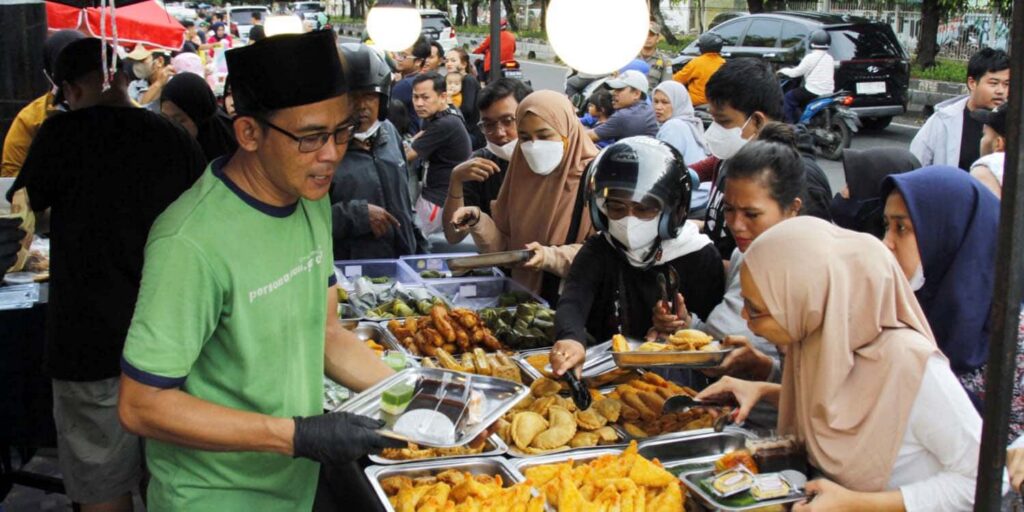
Every Ramadan, Indonesian society is often presented with a unique phenomenon rarely seen in other months, there is war takjil.
In the late afternoon approaching iftar, numerous food and beverage vendors emerge offering a wide variety of takjil. Along roadsides, markets, and residential areas, diverse iftar specialties are attractively displayed.
Not only seasonal traders participate, but many new entrepreneurs also seize the Ramadan momentum to try their luck. This condition has given rise to the term “war takjil,” as if people are competing to secure their favorite takjil.
Interestingly, the excitement of war takjil is not experienced solely by Muslims who are fasting. Last year, a notable phenomenon emerged in which non-Muslim communities also enjoyed the atmosphere of hunting for takjil, making it part of a distinctive social experience during Ramadan.
A lecturer at IPB University, Dr Tjahja Muhandri, who actively mentors micro, small, and medium enterprises (MSMEs), considers war takjil a unique social phenomenon from multiple perspectives. One of its distinctive aspects is the appearance of rare foods and beverages that are seldom found on ordinary days.
“Please check, you will find many foods or drinks that are unavailable on regular days but suddenly appear during Ramadan. They are attractively presented and affordable. The competition for takjil may actually be a competition for ‘nostalgia,’” he said humorously.
He explained that takjil was initially intended for those breaking their fast. However, as public interest increased, among both fasting and non-fasting individuals, the phenomenon demonstrates a very strong market pull.
“When consumers begin competing to buy, it indicates that demand has emerged and the market responds quickly,” he explained.
Furthermore, Dr Tjahja noted that the war takjil phenomenon brings positive impacts for MSMEs. The products offered tend to sell out quickly and are often nearly exhausted. Nevertheless, he reminded MSME actors to remain creative and willing to follow trends.
“As long as MSMEs are willing to follow product trends and not remain monotonous with products that are less favored by consumers,” he said.
From the consumer’s perspective, war takjil makes it easier for the public to find diverse iftar menu options. The wide range of dishes provides families with more choices when breaking their fast.
However, Dr Tjahja also emphasized the importance of hygiene and food safety. He cautioned that the phenomenon opens opportunities for anyone to sell, making supervision of product quality and cleanliness crucial.
“MSMEs must maintain product hygiene, containers, presentation, and even personal cleanliness. Use standard equipment, at minimum masks and clean gloves when serving consumers,” he stated.
He also advised business actors to follow trends, noting that it is acceptable to replicate viral products, and to clearly display selling prices so consumers feel comfortable and do not worry about being overcharged.
“Anyone can set up a stall and start selling. Therefore, hygiene is essential to prevent the risk of food poisoning or illness,” he concluded. (dh) (IAAS/KAL)
