

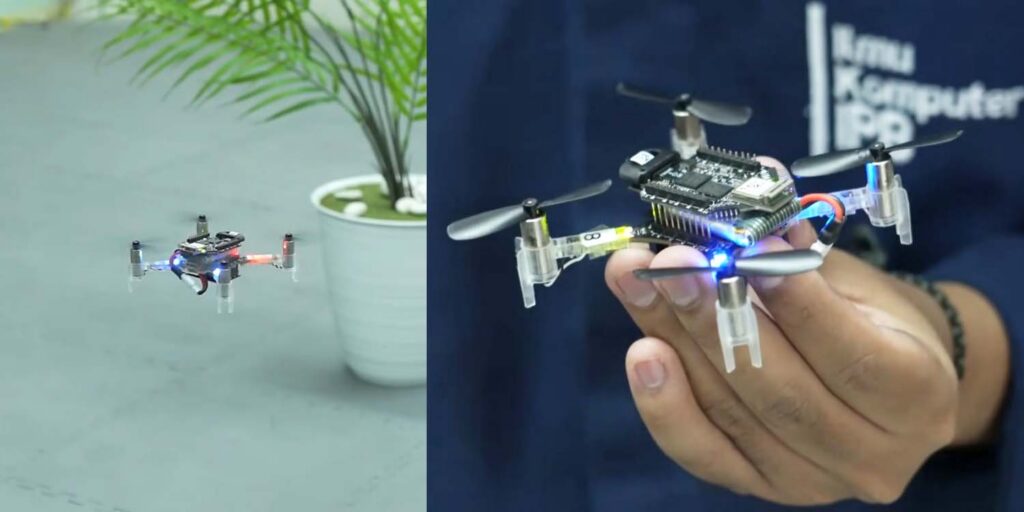
Drone technology and artificial intelligence (AI) open up enormous opportunities in the era of precision agriculture. Two lecturers from the Computer Science Study Program, School of Data Science, Mathematics, and Informatics (SSMI) at IPB University, Dr Karlisa Priandana and Dr Medria Kusuma Dewi Hardhienata, responded to this challenge by developing swarm drone technology.
The development of swarm drone technology for indoor farming is a new innovation in supporting more efficient and precise smart agriculture.
“We initially developed these swarm drones to assist in monitoring or surveillance for indoor farming. Swarm drones are designed as a group of small drones that are able to work coordinately like a swarm of bees,” explained Dr Karlisa.
Indoor farming is a cultivation technique that no longer depends on weather and climate conditions. This is because all agricultural factors, such as temperature, light, and humidity, can be controlled. These conditions require continuous monitoring of the plants.
Until now, monitoring has typically relied on static cameras or sensors. However, these devices are prone to damage. “Swarm drones are used to cover or serve as backup when static sensors experience interference so that monitoring can continue,” she explained.
She revealed that each drone is equipped with a multispectral camera and environmental sensors integrated with the Internet of Things (IoT) system, enabling it to collect comprehensive data on crop conditions.
AI Based Real-Time Analysis
Dr Medria Kusuma Dewi Hardhienata added that all field data is sent in real-time to a central computer for analysis using AI models.
“The results of this analysis help farmers or operators make quick, accurate, and data driven decisions so that crop productivity and quality can be improved,” she said.
Drones capture images of various plant types, which are then analyzed using intelligent algorithms to automatically identify plant species. The AI based communication system also enables drones to interact with each other, adjust formations, and position themselves without colliding, even in the confined spaces of indoor farming.
Looking ahead, swarm drone technology is expected not only to enhance the efficiency of modern agriculture but also to support more environmentally friendly cultivation practices while improving farmers’ well-being through the use of data driven technology. (Fj) (IAAS/FHD)
