

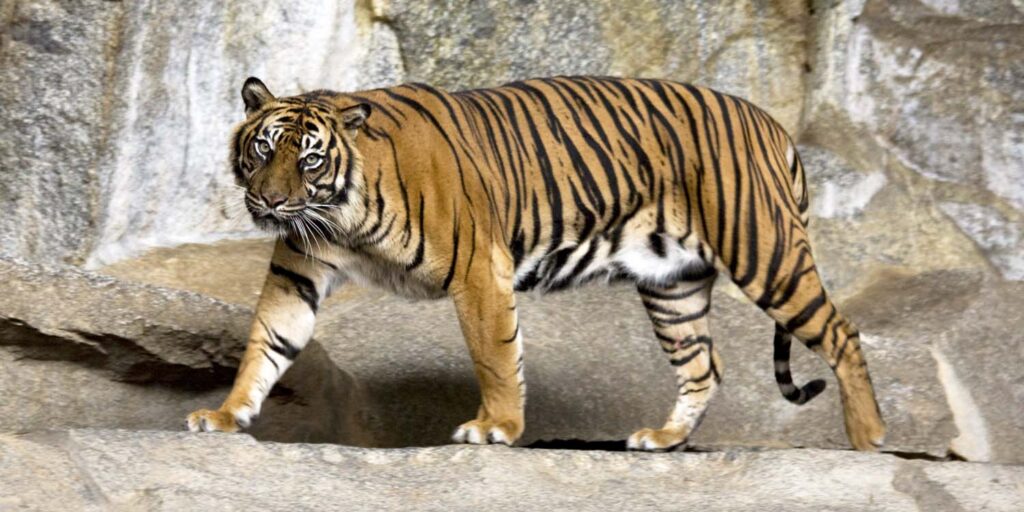
The island of Sumatra is the last habitat for the Sumatran tiger, the only subspecies of tiger that still survives in Indonesia. Unfortunately, forest shrinkage and a decline in prey animals have caused the population of this apex predator to continue to decline in recent years.
This was stated by Prof Ani Mardiastuti, Professor at the Faculty of Forestry and Environment at IPB University, in the IPB Podcast aired on the IPB TV YouTube channel. She explained that the loss of natural habitat and the decline in the population of deer, their main prey, pose a serious threat to the survival of tigers.
“Their numbers are not increasing, nor are they stable; they are actually declining. Tigers are predators, and finding food is difficult. The forests are also becoming increasingly scarce,” she said sadly.
According to her, the Sumatran tiger holds an important position in the ecosystem as an apex predator. Its presence maintains the balance of the food chain and the stability of biodiversity in the forest.
Loss of Prey, Increased Conflict
Prof Ani explained that the decline in natural prey has forced tigers to approach human settlements. This situation often triggers conflict because tigers are forced to prey on residents’ livestock.
“Actually, the community is not anti-tiger. They are just afraid because their livestock is being taken. This is where the dilemma arises between human safety and wildlife conservation,” she said.
She added that clearing forests for various development needs has caused tigers’ habitats to shrink. Sumatra, which was once dominated by forests, has undergone major landscape changes, causing wildlife to lose their homes and food sources.
As a result, tigers are increasingly being captured or relocated after conflicts arise, which ultimately accelerates the decline of their population in the wild.
If Extinct, the Balance of Nature is Disrupted
Prof Ani emphasized that the extinction of tigers does not only mean the loss of one species, but also has an impact on the ecosystem as a whole. Apex predators play a role in controlling the population of herbivores so that they do not destroy forest vegetation.
“There are more and more wild animals, and the earth is becoming more balanced. If this balance is disrupted, the impact is often only felt decades later,” she explained.
She cited research in America that showed the loss of predators caused major changes to the forest ecosystem. Without predators, prey populations increased uncontrollably and damaged plant regeneration.
As a conservation effort, Prof Ani emphasized the importance of preserving habitats and ensuring the availability of natural prey such as deer. She also urged the public not to trade in wild animal parts and to raise public awareness through education and conservation campaigns.
“Before it’s too late, let’s try to save them. Conservation is not only the government’s responsibility, but the responsibility of us all,” she concluded. (Fj) (IAAS/KQA)
