

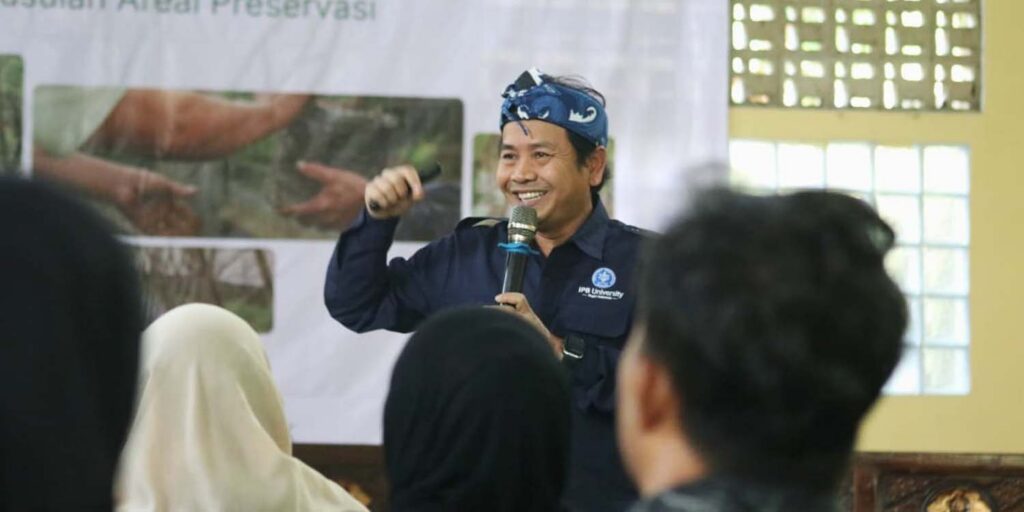
The Department of Conservation of Forest Resources and Ecotourism (DKSHE), Faculty of Forestry and Environment (Fahutan), brought together farmers from villages surrounding Gunung Halimun Salak National Park (TNGHS) with experts and researchers from IPB University to strengthen their capacity for sustainable land management.
Through the FOLU Net Sink 2030 Implementing Partner program, farmers from four intervention villages, which are Cihamerang, Kabandungan, Cipeuteuy, and Mekarjaya in Sukabumi Regency, received various trainings and direct guidance from IPB University experts, including sessions on chili cultivation and land management.
Prof Muhammad Syukur, a Full Professor in the Department of Agronomy and Horticulture at IPB University’s Faculty of Agriculture, presented a session titled “Seven Keys to Successful Chili Cultivation”. As an expert in plant genetics and breeding, Prof Syukur is known for developing various high-yielding chili varieties with strong adaptability to diverse environmental conditions.
“The success of chili cultivation is influenced by various factors, ranging from the selection of high-yielding varieties and quality seeds, land preparation, balanced fertilization, water management, to the control of pests and plant diseases,” he said.
The event also featured Prof Arief Hartono, a professor in the Department of Soil Science and Land Resource at the Faculty of Agriculture, IPB University, who provided insights into soil characteristics and fertility. Participants learned about the nutrients needed by plants, factors affecting soil conditions, and the use of simple tools to evaluate land.
In addition to classroom learning, farmers participated in a field demonstration led by Dr Endang Gunawan, an IPB University lecturer specializing in crop production. Participants practiced MPTS crop maintenance techniques, ranging from weed control and fertilization to plant care during the early growth stages.
Hasari, SP, MP, a representative from the Sukabumi Regency Agriculture Office, commended the event. “The program is excellent and very helpful for farmers. Today’s topic, in particular, supports the development of Kabandungan Subdistrict as a chili pepper hub in West Java,” he said.
Through this series of training sessions, the Department of KSHE at IPB University hopes that communities in the four buffer zone villages surrounding TNGHS will further develop their capacity to manage land sustainably, increase agricultural productivity, and optimize the use of MPTS crops as well as other flagship commodities.
This capacity building is expected to serve as a key asset in supporting the process of proposing preservation areas, while also striking a balance between improving community well-being, conserving biodiversity, and achieving the 2030 FOLU Net Sink target. (*/Rz) (IAAS/DAM)
