

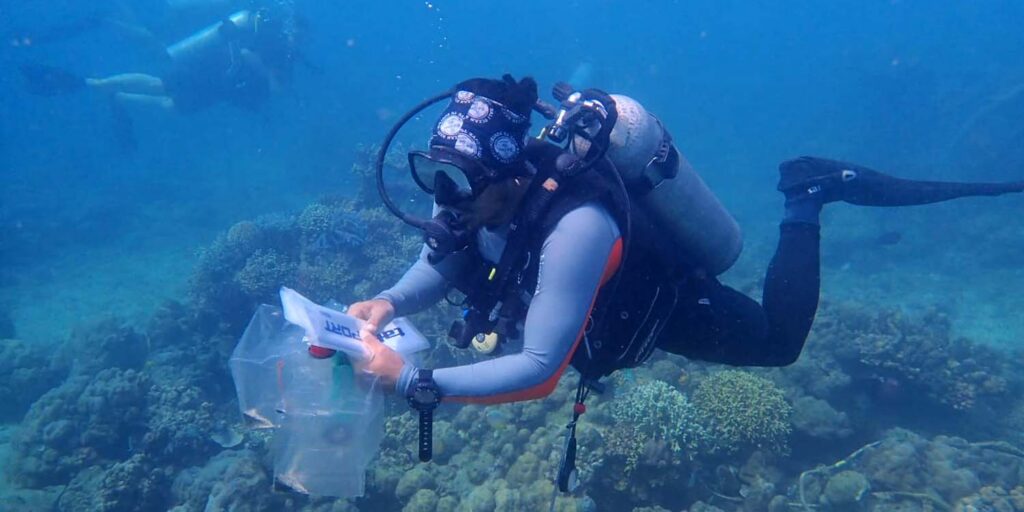
A research team from the Faculty of Fisheries and Marine Sciences (FPIK) at IPB University has utilized the advanced technology of environmental DNA (eDNA) to map and uncover biodiversity in the Biorock-based coral reef restoration area in Pemuteran Village, Buleleng Regency, Bali.
This innovative step in global marine conservation is expected to provide far more accurate and comprehensive ecological data regarding the positive impacts of coral restoration on surrounding ecosystems.
Pemuteran Village has long been recognized internationally as one of the world’s largest and most successful coral reef restoration sites using the Biorock method.
Before being replicated in Bali to obtain a more complete, comparative, and in-depth ecological picture, this genetic monitoring approach had already been successfully applied by FPIK IPB to detect hidden species diversity in the coral reef restoration area of Sangiang Island, Banten.
Dr Beginer Subhan, a Marine Biology Expert at IPB University, explained that the use of eDNA enables researchers to uncover marine biodiversity that has largely gone undetected by conventional visual surveys, as many organisms living deep within coral structures have yet to be properly documented.
“With eDNA technology, we can reveal more hidden biodiversity within each microhabitat surrounding the Biorock restoration area,” he said.
This environmental DNA technology works by collecting DNA samples released by organisms into seawater through mucus, feces, urine, or shed skin tissue. The method is non invasive and environmentally friendly, as researchers do not need to capture or disturb marine organisms.
Through laboratory analysis using Next-Generation Sequencing, eDNA offers high accuracy and sensitivity in identifying rare, protected, and nocturnal species that inhabit narrow crevices within Biorock structures, which are difficult for divers to monitor manually.
The innovation has received support from Tom Goreau, President of the Global Coral Reef Alliance (GCRA) and the inventor of Biorock technology. According to him, integrating Biorock based physical restoration with molecular monitoring using eDNA will establish a new global standard for evaluating coral reef restoration success.
Meanwhile, Komang Astika of the Karang Lestari Foundation/Biorock Indonesia emphasized the importance of this collaboration for the sustainability of the local environment. He hopes that the data generated by IPB University will attract greater international interest in studying the ecosystems of Pemuteran.
“We hope that more researchers, both from Indonesia and abroad, will come to conduct studies in Pemuteran. Scientific collaborations like this are essential to ensuring the long-term sustainability and health of Bali’s marine ecosystems,” Komang concluded. (*/Rz)(IAAS/PRP)
