

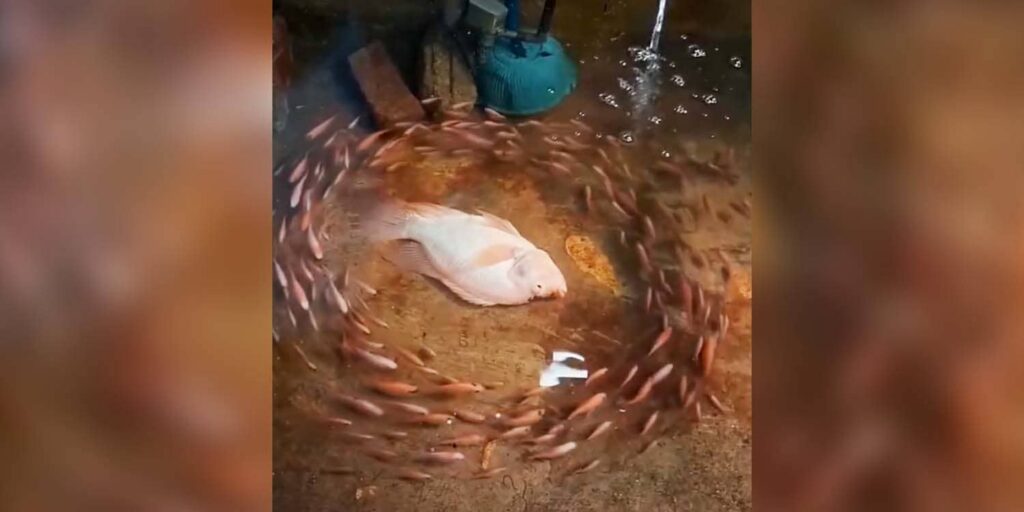
The phenomenon of animals circling objects, carcasses, or other weak individuals often gives rise to various interpretations in society, including mystical views. However, according to IPB University Animal Behavior Expert Dr Supratikno, this phenomenon is part of an animal’s natural response that can be explained scientifically.
Dr drh Supratikno explained that the behavior of circling other individuals in fish, birds, and mammals is an indirect effect of behavioral and chemical communication between animals.
“In the case of fish that appear weak or near death and are surrounded by smaller fish, what is actually happening is that the fish is releasing stress hormones or other chemical substances. These substances are detected by the surrounding fish and attract them to approach,” he said.
He emphasized that the approaching fish do not intend to help. “They want to identify whether the fish is dead or not. Dead fish are a food source because in nature, there is a very efficient law where no resources are wasted.”
“Additionally, if the weak fish was previously a dominant individual, other fish will approach to threaten and take over dominance,” he explained.
However, under certain conditions, fish that were previously weak can recover. This usually occurs in fish that are lacking oxygen, not because of disease. “The circular movements of other fish create a water flow that helps supply oxygen to the gills. In addition, the spinning motion may be perceived as a threat by other fish.”
“Instinctively, when faced with this threat, the previously weak fish will try to avoid danger and move, automatically opening its operculum so that its gills can resume their function of taking in oxygen,” he added.
A similar phenomenon can be seen in turkeys circling the carcasses of predators. According to Dr Supratikno, this behavior is an instinct of caution. “Turkeys make sure that the predator is really dead and not just pretending to be dead. For young individuals, this activity also serves as a learning process to recognize the characteristics of predators,” he said.
In ants, the behavior of circling objects is related to collective identification. “Ants circle objects to determine whether they are food, carcasses, or threats. They also leave pheromones as markers of demarcation zones to localize danger,” he explained. These demarcation zones lock the circled objects in place so they cannot escape, or conversely, so that no individuals from other groups can enter. While circling, ants also release pheromones to call their companions.
Meanwhile, in sheep, circling behavior is influenced by social structure. “As social ruminants, sheep follow the behavior of the group leader. Circling movements are performed to assess potential danger, respond to unfamiliar smells, and mark territory,” he said.
He emphasized that all of these behaviors are rooted in the instinct to survive. “Social animals use group behavior to increase strength, reduce stress, and disrupt the concentration of predators,” he said.
He also clarified the mystical views that often arise and are often associated with animal behavior. “Basically, every animal has senses with different sensitivities that sometimes cannot be felt by other animals.”
Additionally, the law of ecosystem efficiency dictates that no energy is wasted. “This means that if a resource is about to die, other creatures will instinctively utilize it,” he concluded. (AS) (IAAS/KDP)
