

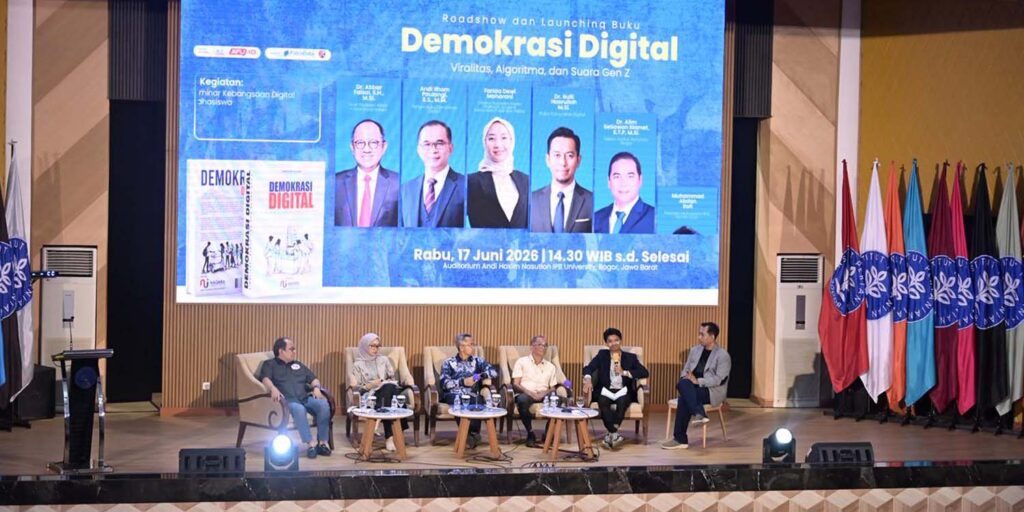
The development of social media has transformed the face of democracy in the digital era. Not only serving as a means of communication, the digital space has now become an arena for the formation of public opinion, political participation, and social decision-making. This phenomenon became the main discussion in the book discussion and launch event of Digital Democracy: Virality, Algorithms, and the Voice of Gen Z at the Andi Hakim Nasution Auditorium, IPB Dramaga Campus, Bogor, Wednesday (6/18).
The Minister of Communication and Digital of the Republic of Indonesia, Meutya Viada Hafid, BEng, MIP, who attended virtually, said that democracy today does not only live in formal spaces, but also across various digital platforms used by the public every day.
According to her, the public needs to be aware that the digital space does not always represent reality in its entirety. Algorithms often create what is referred to as an illusion of reality, a condition in which a person feels that all of society shares the same view. In fact, what is visible is merely the result of algorithmic filtering.
Therefore, she invited the younger generation not only to be users of technology, but to become a generation that is critical in understanding information and the context that develops in the digital space. “Use the digital space to strengthen togetherness, not to widen differences,” she conveyed.
On that occasion, the Vice Rector of IPB University for Education and Student Affairs, Prof Deni Noviana, affirmed that virality, algorithms, and the voice of Gen Z are three important elements that shape the current digital democracy landscape. He reminded that algorithms not only determine the information seen by the public, but also have the potential to create echo chambers that narrow the space for dialogue with groups of differing views.
Therefore, according to him, higher education institutions have a responsibility to produce capable and ethical digital citizens who are able to think critically and are not easily trapped in misleading streams of information.
“Show the world that Gen Z of IPB University is a generation that not only knows how to scroll, but is also capable of thinking. A generation that is not only skilled at giving likes, but also genuinely makes contributions,” he conveyed.
Meanwhile, the author of Digital Democracy, Andi Ilham Paulangi, MM, explained that his book seeks to capture the changes in democracy that have occurred as a result of digital technology development through the phenomena of virality, algorithms, and the increasing participation of the younger generation in the public sphere.
According to him, the public sphere that was once present through mass media and conventional discussion spaces has now shifted to the digital space. Social media and various digital platforms have become new spaces for the public to discuss, convey aspirations, and build public opinion.
Andi added that these changes have enabled the emergence of broader public participation. However, on the other hand, technological developments also present challenges in the form of algorithmic dominance in determining the flow of information and shaping public opinion.
Therefore, the speakers agreed that digital literacy is the key to maintaining the quality of democracy in the digital era. The public needs to understand how algorithms work, be able to verify information, and use social media responsibly so that the digital space remains healthy, inclusive, and productive. (AS)(IAAS/PRP)
