

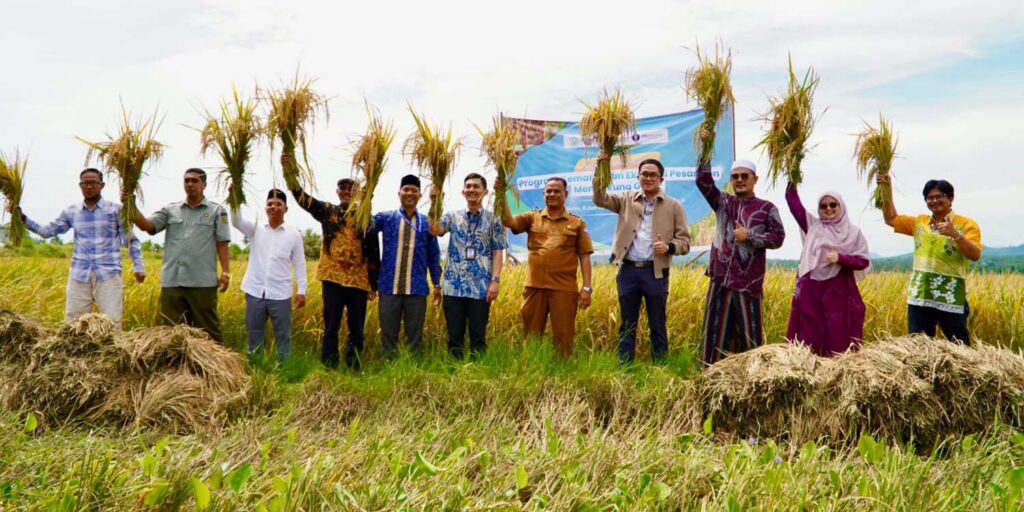
The Center for Islamic Business and Economics Studies (CI-BEST) at IPB University is developing a pesantren based rice ecosystem through the Boarding Economic Self Reliance Program, which is part of the National Movement for Food Inflation Control (GNPIP). In collaboration with Bank Indonesia, the program is being implemented at the Ummul Ayman III Islamic Boarding School in Pidie Jaya Regency, Aceh, utilizing high yielding rice varieties developed through IPB University’s innovations.
During the demonstration farm harvest event (6/8), the IPB University team introduced two high-yielding rice varieties: IPB 13S and IPB 15S. Specifically, the IPB 13S variety has a potential yield of 11 to 11,5 tons per hectare based on previous test results.
Dr Ahmad Junaedi, Coordinator of the IPB University Rice Research Group and representative of CI-BEST IPB University, explained that these varieties represent a new generation of rice designed to address future agricultural challenges.
“IPB 13S is a climate smart variety that offers high productivity, requires less fertilizer and water, and can adapt to drought conditions. This innovation is expected to help farmers cope with the challenges of climate change while boosting farm productivity,” he said.
In addition to introducing high yielding varieties, IPB University has also implemented plant bio-immunization technology and provided guidance on modern cultivation practices. As part of efforts to strengthen precision agriculture, the team installed automatic weather stations (AWS) that allow farmers to monitor weather conditions in real time via their smartphones. This technology helps farmers anticipate the risks of drought, pest and disease outbreaks, and various extreme weather conditions that can affect crop yields.
This program not only focuses on increasing cultivation productivity but also on building an integrated rice business ecosystem from upstream to downstream. This support includes the provision of high yielding seeds, cultivation guidance, post-harvest strengthening, and processing of the harvest through a rice milling unit (RMU) with a capacity of 1,5 tons per hour.
Currently, the Ummul Ayman Islamic Boarding School manages approximately 80 hectares of rice fields, cultivated in collaboration with the local community and the school’s teachers. This business model supports the boarding school’s internal consumption needs amounting to about one ton of rice per day while also serving as a vehicle for community economic empowerment.
A representative from Bank Indonesia, Yason Taufik Akbar, MSc, stated that strengthening the food sector is a crucial part of efforts to maintain inflation stability and improve public welfare.
“Through this program, we are not only encouraging increased production but also strengthening the trade system, institutions, and business networks of Islamic boarding schools to create a sustainable business model that can be replicated in various regions,” he said.
The harvest event was also attended by the Regional Secretary of Pidie Jaya Regency, Dr Munawar Ibrahim, local government officials, Baitul Mal Aceh, farmer groups, IPB University alumni, and various other stakeholders.
The Regional Secretary of Pidie Jaya noted that the success of the demonstration farm serves as a symbol of the resurgence of the local agricultural sector following the floods that struck the region.
The GNPIP Based Boarding Economic Independence Program is a collaboration that has been developed since 2024 by Bank Indonesia in partnership with IPB University and is currently being implemented at various partner pesantren in Aceh, West Java, and East Java. The program covers the strengthening of cultivation, post-harvest activities, product downstreaming, business institutional development, market access expansion, and financing. (*/Rz)(IAAS/LAN)
