

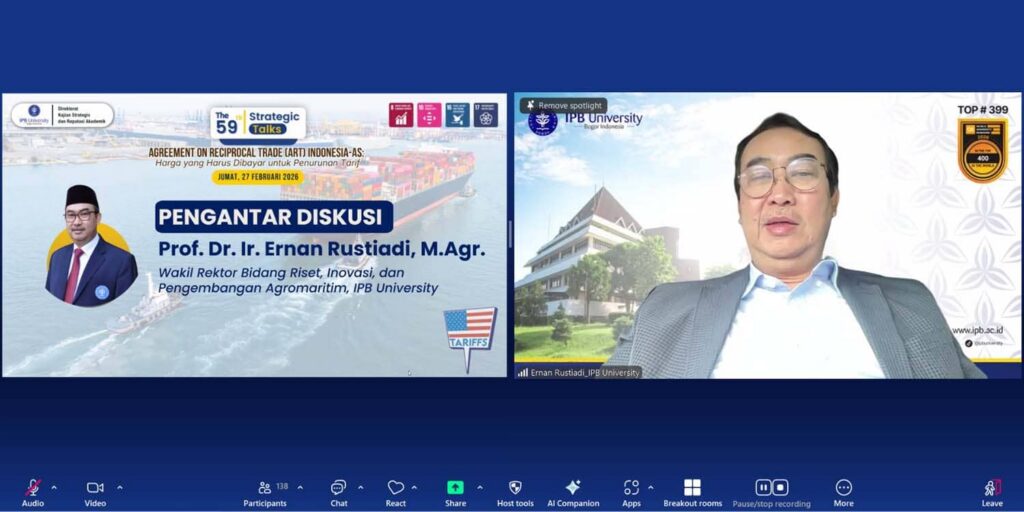
IPB University, through its Directorate of Strategic Studies and Academic Reputation (DKSRA), responded to the Agreement on Reciprocal Trade (ART) between Indonesia and the United States by presenting the 59th IPB Strategic Talks (2/28). The discussion highlighted the economic, sectoral, and geopolitical dimensions of the ART, as well as the risks that the government needs to anticipate.
In his introduction to the event, IPB University Vice Rector for Research, Innovation, and Agromaritime Development, Prof Ernan Rustiadi, emphasized the importance of adaptation in determining the most appropriate policy measures in response to changes in the international trade landscape.
From an economic analysis perspective, Prof Sahara, Professor of Agricultural Policy Economics at IPB University, presented a study based on a computable general equilibrium (CGE) model.
The results of the study show that the scenario of a tariff reduction from 32% to 19% still poses a risk of putting pressure on the Indonesian economy. Meanwhile, the United States has the potential to benefit through import substitution.
“A scenario of reducing tariffs to 15% could mitigate the severity of the impact, but projections still indicate risks for Indonesia,” she said. This analysis also confirms that the challenge of competitiveness lies not only in tariffs but also in structural issues such as logistics costs and labor productivity.
Executive Director of the Institute for Development of Economics and Finance (INDEF) Dr Tauhid Ahmad discussed the impact from the perspective of strategic commodities and political economy.
“Indonesia’s dependence on palm oil exports contributes significantly to foreign exchange earnings. However, it also increases vulnerability when market access is disrupted by the policies or standards of trading partners,” he explained.
He also highlighted the issue of cooking oil prices, which are linked to international price dynamics and global oil market volatility. In the context of the ART, he continued, it is important to ensure that the agreement does not disrupt existing partnerships.
Therefore, he emphasized the need for mitigation strategies that protect domestic industries and consumers, including strengthening cooperation with like minded countries such as Malaysia and Australia.
Meanwhile, IPB University Professor of Agribusiness Prof Bayu Krisnamurthi highlighted the aspects of governance and balance of commitments in the ART. Formalities and constitutional mandates must be fulfilled. On the other hand, the structure of obligations between parties needs to be carefully reviewed because it has the potential to create economic pressure, including the risk of inflation and a decline in welfare, if mitigation is not prepared from the outset.
“Geostrategic analysis and market diversification are also needed to strengthen Indonesia’s position amid changes in the global trade map,” he added.
The discussion also highlighted potential non-tariff barriers, including environmental and labor standards that could restrict market access and affect certain commodities. Therefore, the forum encouraged the government to conduct a comprehensive review not only of tariff aspects, but also of non-tariff consequences and their sectoral implications. (*/Rz) (IAAS/HLF)
