

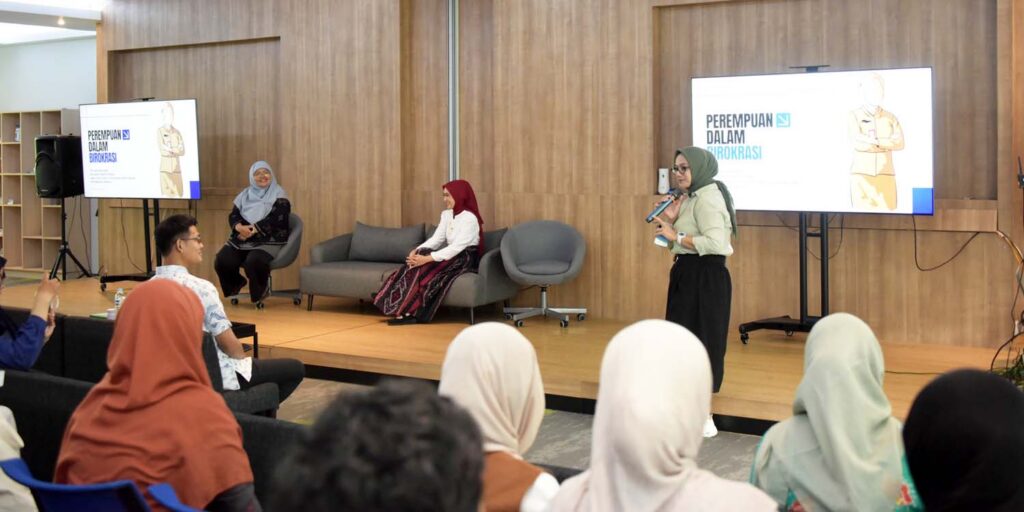
To commemorate Kartini Day, the Directorate of Career Development, Entrepreneurship, and Alumni Relations (DPKKHA) and Agrianita IPB University held a sharing session titled “Women in Career: Carrying Kartini’s Spirit into Global Industries and Governance.”
This event addressed the realities and challenges women face in building their careers in the modern era, both in the industrial sector and in government sector.
Director of DPKKHA Puji Mudiana, SP, MA, stated that IPB University continues to strive to strengthen students’ career readiness through various programs, one of which is the Alumni Tracer Study.
“Based on tracer study data, there is a disparity in achievements between female and male graduates. The average starting salary for female graduates is Rp4,5 million with an average job search period of approximately 3,6 months, while male graduates have an average starting salary of Rp5,2 million with a job search period of 3,4 months,” she explained.
During the presentation session, Chairperson of Agrianita IPB University, Suci Nur Aini Zaida, stated that the presence of women brings important values to the bureaucracy, such as empathy, collaboration, integrity, and service innovation.
“These values provide a perspective that enriches the decision-making process and improves the quality of public services,” said the Senior Spatial Planning Expert at the DKI Jakarta Provincial Department of Public Works, Spatial Planning, and Land Affairs.
Nevertheless, she revealed that women in the bureaucracy still face disparities, particularly in access to strategic positions.
“The number of female civil servants continues to rise and even dominates in terms of numbers. However, in structural positions, women’s representation still lags far behind that of men. While statistics show an increase, the disparity remains clearly visible at the decision making level,” she explained.
In the workplace, she noted, women are often treated differently for instance, they are not encouraged to take on direct fieldwork. Yet, in terms of technical competence, women’s capabilities are deemed equal. This situation forces women to work harder to gain recognition.
According to her, social factors also influence women’s career development. Domestic roles, such as childcare, are still largely shouldered by women. In difficult economic conditions, women are often the most affected, making their career paths even more challenging.
In addition, Anindita Sita Dewi shared her perspective on the importance of having the courage to grow and stand out. For her, every individual has their own journey, and the process itself is a crucial part of developing skills, including soft skills. (Ez) (IAAS/HLF)
