

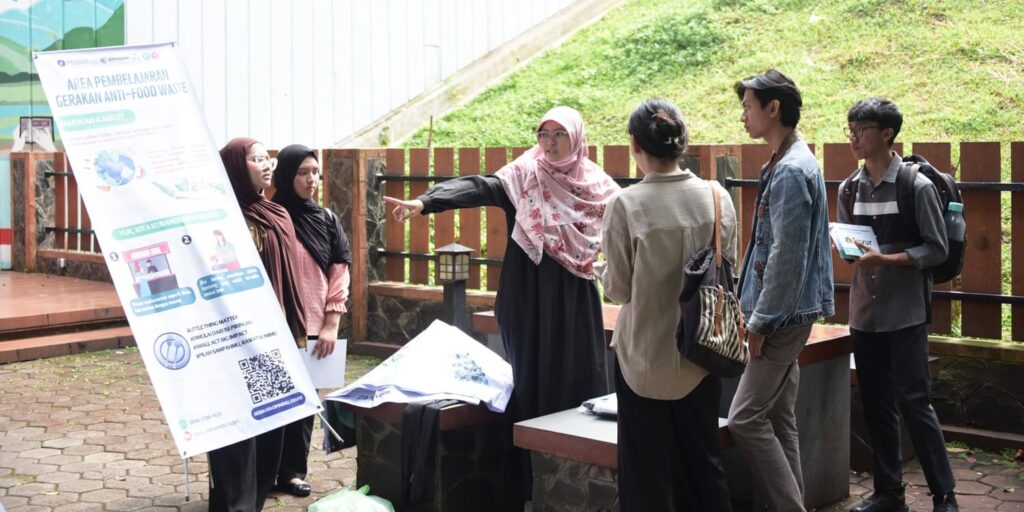
Amidst the rampant problem of food waste in Indonesia, IPB University reaffirms its role as a sustainable campus through Zero Food Waste Action, part of the Sustainable Solution Champions (SSC) movement.
This program involves students in raising awareness of wise food management and reducing food waste on campus.
The Zero Food Waste Initiative began at two pilot cafeterias, Sapta Cafeteria and Plasma Cafeteria, and ran for eight days (10/20–27). Through this program, students are not only encouraged to finish their food, but also to understand how to utilize organic waste, one of which is through the use of maggots, as is done at Taman Semangat, the final waste disposal site (TPA) at the IPB Dramaga Campus.
According to Dr Rina Mardiana, the pioneer of the SSC movement, this action was born out of her concern about the habit of students who often leave food uneaten.
“Students eating at the cafeteria often leave food behind, and this is common. Abroad, people bring their own utensils and clean up their leftovers. Here, consumers often feel satisfied after eating and simply leave the rest,” she said.
She emphasized that this initiative is not merely a campaign to finish food but also about fostering habits and individual moral awareness among students.
“We want to build a sustainable movement that has an impact on the environment. Because IPB has a large number of students, behavioral change must start with them,” she added.
During the eight days of implementation, student volunteers educated visitors and canteen vendors, while weighing and recording the amount of food waste every afternoon. This approach refers to Indonesian National Standard (SNI) 19-3964-1994 on waste calculation.
One of the participants, Aufa, a student at the Faculty of Human Ecology at IPB University, believes that this activity raises new awareness about waste management.
“The problem is not that students don’t know about food waste, but that they lack awareness. They know, but it hasn’t reached their hearts. This action makes us realize that change starts with ourselves,” he said.
Dr Rina emphasized that this movement will continue to be developed in various forms of other student actions, such as reducing plastic waste and saving energy.
“At least after graduating, students can say: I have done this action. From there, a sustainable individual moral awareness grows,” she said.
In addition to the Zero Food Waste initiative, the Sustainable Solution Champion program includes Planet X (a plastic-free campaign), EcoWalk (a walking activity while enjoying the beauty of the campus), and Biodiscovery (campus biodiversity education). Starting with 350 students, Dr Rina is confident that this movement can serve as an example to promote behavior. (IAAS/LAN)
