

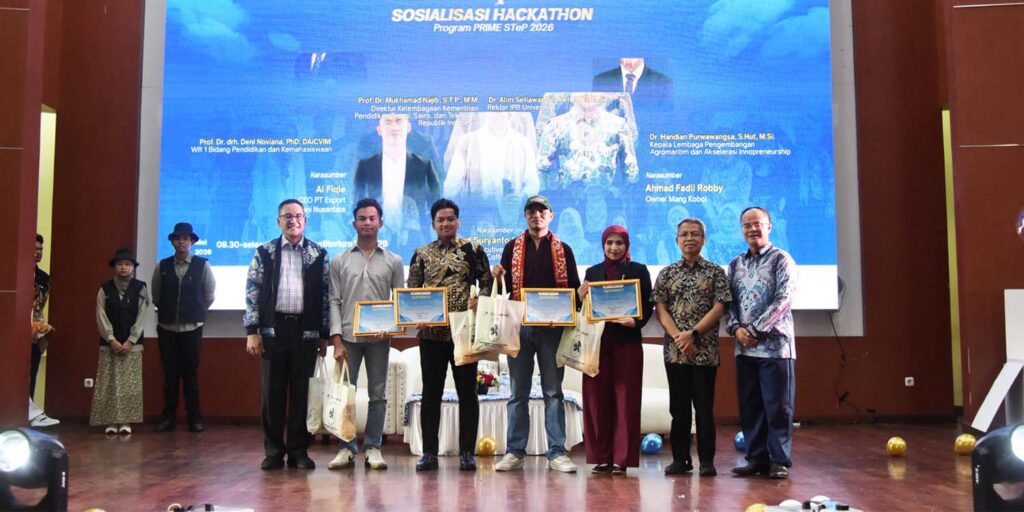
IPB University, through the Institute for Agromaritime Development and Innovation Entrepreneurship Acceleration (LPA2I), has officially launched the Agromaritime Sociopreneur Academy (ASA) 2026 program.
The event was held at the Auditorium of the Faculty of Economics and Management, IPB Dramaga Campus (5/2). This program is designed to prepare the younger generation, particularly students, to be able to create value while generating employment opportunities in the agromaritime sector.
The Chairman of LPA2I at IPB University, Dr Handian Purwawangsa, explained that ASA is a flagship program born from IPB’s commitment to cultivating young technosociopreneurs who prioritize social interests.
“ASA continues to grow year after year, from the quality of the program, the number of thematic schools, to the consistently increasing number of participants,” he said.
He noted that ASA 2026 is open to students from all faculties at IPB University as well as the general public. By the end of April, the number of applicants had reached over 160 and is expected to continue rising.
Selected participants will undergo a series of integrated training through the CEO School, which focuses on enhancing leadership, entrepreneurial skills, and the development of technosociopreneurs.
The program is divided into six fields: drone mapping, coffee and its derivatives, high quality fruit commodities, food crops, poultry, and freshwater fisheries.
“The program’s implementation also involves faculty members and industry practitioners, complemented by industrial visits and real-world projects to provide comprehensive training,” he added.
In addition to ASA, the PRIME STeP Hackathon program was also introduced during the same event, serving as a platform for collaboration among students, faculty, investors, and industry. This program targets the top 35 innovator teams with funding support as a form of campus based startup acceleration.
The Vice Rector for Education and Student Affairs at IPB University, Prof Deni Noviana, emphasized that both programs are designed to cultivate graduates with a solution oriented mindset.
“We want students not only to be observers of social issues but to become technosociopreneurs capable of integrating local wisdom with digital innovation,” he explained.
According to him, the PRIME STeP Hackathon serves as a concrete step in propelling pre-incubation startups to the next level, with simulated funding of up to Rp50 million per team.
He also stressed the importance of interdisciplinary collaboration to address various challenges, ranging from food security to health and biosciences.
“Don’t be afraid of complexity. Complex problems are opportunities for innovation. Build strong collaborations and use funding as validation of your ideas in the market,” he advised.
Prof Mukhamad Najib, Director of Institutional Affairs at the Directorate General of Higher Education, Ministry of Higher Education, Science, and Technology (Kemdiktisaintek) of the Republic of Indonesia, who was also present, highlighted the importance of strengthening the social entrepreneurship ecosystem in driving national transformation toward Indonesia Maju 2045.
“We must break free from the middle income trap with two key pillars: high quality human resources and innovation capabilities,” he stated.
He added that the demographic dividend must be harnessed by fostering a productive generation that not only seeks employment but also creates job opportunities.
In his view, the socioentrepreneurship approach serves as a strategic solution because it integrates innovation, sustainability, and social impact within a single development framework.
“Moving forward, our challenge is to ensure that programs like this do not end as mere ceremonial events, but remain sustainable and have access to financing as well as a strong market,” he concluded. (AS) (IAAS/WSG)
