

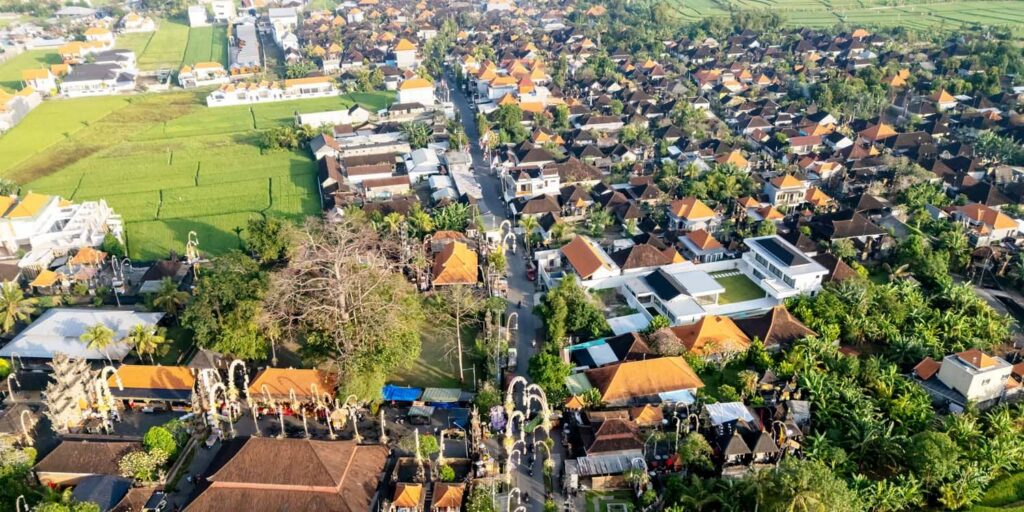
Amidst abundant agromaritime resources, more than 70.000 villages in Indonesia from Sabang to Merauke still face various development paradoxes. The state is considered to have not yet fully succeeded in providing sovereignty and prosperity for its own people in rural areas.
This was emphasized by the Dean of the Faculty of Human Ecology (Fema) at IPB University, Prof Sofyan Sjaf, in a Kauniyah Study entitled “Villages as the Meeting Point of Ecology and Economy in Science Based Development” at the Al Hurriyyah Mosque, IPB University, on Thursday (2/26).
“From the Village Welfare Index (IKD) data, it is evident that many villages are still in the middle and low zones. This means that many Indonesians in villages are not yet prosperous,” he said.
The author of the book Involusi Republik Merdeka explained that this condition is allegedly due to misguided development that does not touch on the realm of earth’s prosperity. He offered a solution for village management by referring to the principles in the Quran.
“There are two terms that refer to villages in the Quran, namely qaryah or social community, and balad which means a living area. So, a village is a social moral entity and is not limited to geography alone,” he explained.
According to him, the characteristics of an ideal village are based on solidarity and oriented towards justice. Villages will be very vulnerable to destruction if there are inequalities within them.
For this reason, he emphasized that building a village based on the Quran is the same as building ecology. Nature must be used as a benchmark. It is a kauniyah verse that is mizan or balanced.
“Stop logging and littering. Nature should not be destroyed (fasad) and should not be overexploited (israf),” he explained. He also reminded us of the message in QS An-Nahl verse 112, that a prosperous country can collapse due to social disbelief.
As a solution, Prof Sofyan formulated three main foundations in building a village, namely tauhid, khalifah (humans as managers, not absolute owners), and amanah. He also underlined three crucial formulations that must be avoided.
“Economy without ecology leads to exploitation. Ecology without justice triggers conflict. And villages without governance will result in inequality,” he asserted.
Through this approach of tauhid and ecology, he hopes that in the future, a ‘Blessed Village’ can be realized a village characterized by preserved ecology, fair economic distribution, strong social solidarity, and participatory governance. (*/Rz) (IAAS/LAN)
