

IPB University and CIMB Niaga Syariah Collaborate to Strengthen MSMEs and Inclusive Access to Education
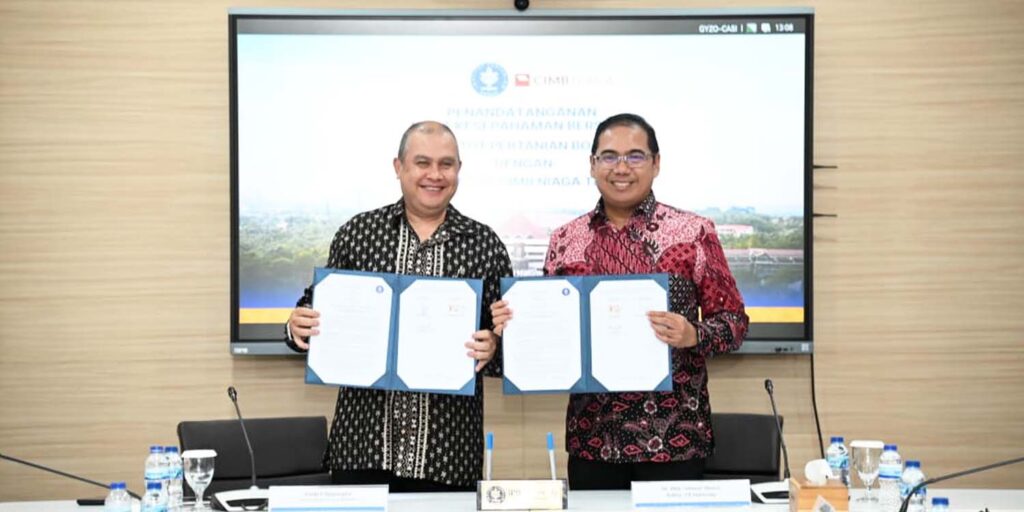
IPB University has established a strategic partnership with PT Bank CIMB Niaga to strengthen the development of the micro, small, and medium enterprises (MSMEs) sector, education, and digital based innovation through the signing of a memorandum of understanding at the IPB Dramaga Campus, (5/6).
The collaboration between IPB University and Bank CIMB Niaga marks a concrete step toward encouraging the integration of the education and economic sectors, particularly in strengthening MSMEs and expanding access to inclusive finance.
This collaboration is expected to address various challenges, ranging from limited access to financing to the gap between regulations and the actual needs of business actors.
The Rector of IPB University, Dr Alim Setiawan Slamet, stated that IPB University is open to various forms of collaboration. He emphasized that partnerships are not merely formal relationships, but also collective efforts to encourage educational transformation and community empowerment.
In his statement, he explained that nearly 44 percent of IPB University students come from economically disadvantaged families, making scholarship support and access to financing highly crucial. “We uphold the principle that no student should discontinue their studies due to financial reasons,” he said.
Furthermore, IPB University has actively engaged in community empowerment through various programs, such as the development of assisted villages and research based innovations that have reached thousands of villages across Indonesia. Collaboration with the banking sector is expected to accelerate the downstream implementation of these innovations.
Meanwhile, the Director of Sharia Banking at Bank CIMB Niaga Tbk, Pandji P Djajanegara, stated that the company is targeting the retail and MSMEs sectors as its primary focus for future business development.
He emphasized that collaboration with IPB University presents a strategic opportunity to address various challenges in the field. “We hope this collaboration can be implemented effectively soon, especially in supporting MSMEs development,” he said.
He also added that one of the biggest challenges in the MSMEs sector today is the mismatch between regulations, educational incentives, and industry needs.
Therefore, synergy with educational institutions is considered essential in delivering more applicable and sustainable solutions.
Through this collaboration, both parties are optimistic that they can create an ecosystem that supports inclusive economic growth while sustainably improving the quality of national education. (dr) (IAAS/ADF)
