

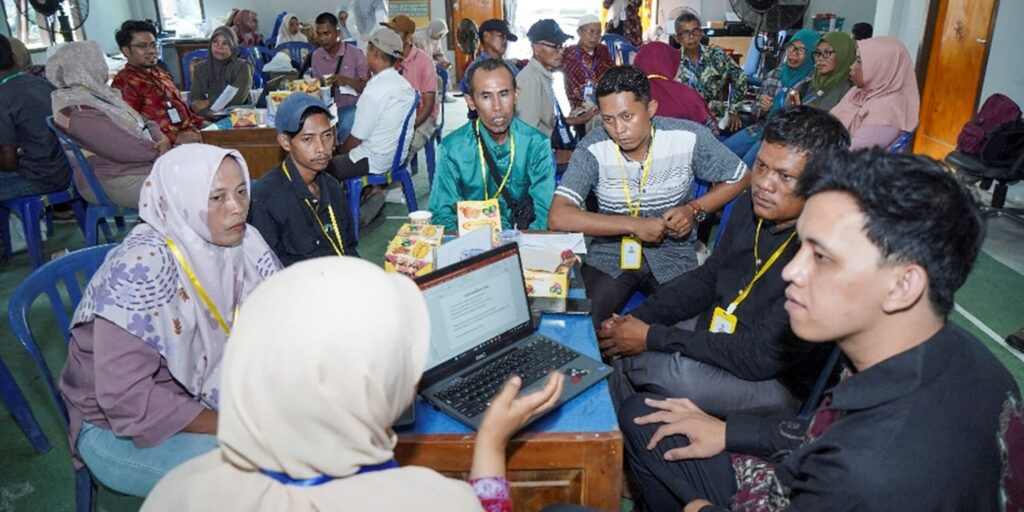
IPB University and Ghent University Belgium collaborated to carry out activities to strengthen the capacity of catfish farmers in Lubuk Ruso Village, Pemayung District, Batanghari Regency, Jambi.
This program was carried out through the VLIRUOS Short Initiative (SI) scheme. The team explored field achievements, technical obstacles, and opportunities for innovation in the implementation of independent feed in catfish farming.
The chairperson of the research team, Prof Julie Ekasari, said that this program is expected to strengthen feed independence for catfish farmers in Jambi while increasing the competitiveness of Indonesian catfish commodities in the national and international markets through a sustainable innovation approach.
The results of the focus group discussion (FGD) showed that the production of independent feed based on local raw materials, such as salted fish, copra meal, and poles, was considered more cost-efficient, ranging from Rp6.000 to Rp7.000/kg compared to commercial feed, which costs Rp10.000 to Rp15.000/kg.
However, Prof Julie noted that challenges remain, particularly regarding the stability of raw material supply, limited mixing and drying equipment, and differences in formulation knowledge among farmers.
In addition, the team reviewed technical aspects of cultivation, including the impact of independent feed on water quality, feed consumption levels and feed conversion ratio (FCR), as well as production estimates and harvest times.
“Although independent feed prolongs the maintenance period and increases the risk of water quality deterioration, many farmers still choose it because it generates greater profit margins, especially when combined with commercial feed in the early stages of growth,” said Prof Julie.
Through this activity, farmers also conveyed their priority needs, such as further training on feed formulation, independent feed production procedures, the provision of mixing and drying machines, raw material storage facilities, fish health assistance, and support for superior seeds.
“The plan is for the team to develop SOPs (standard operating procedures) based on FGD results, advanced technical training on independent feed production, and the development of a collaboration model based on farmer groups,” she said.
The FGD was attended by academics, catfish farmers, local government officials, and stakeholders in the aquaculture sector. The event was opened by the Jambi Province Marine and Fisheries Service; the Batanghari Regency Food, Agriculture, and Fisheries Service; and Ghent University promoter Prof Annelies Declercq. The panel discussion also featured speakers from academia, fisheries agencies, and independent feed producers and catfish farmers. (*/Rz) (IAAS/NRA)
