

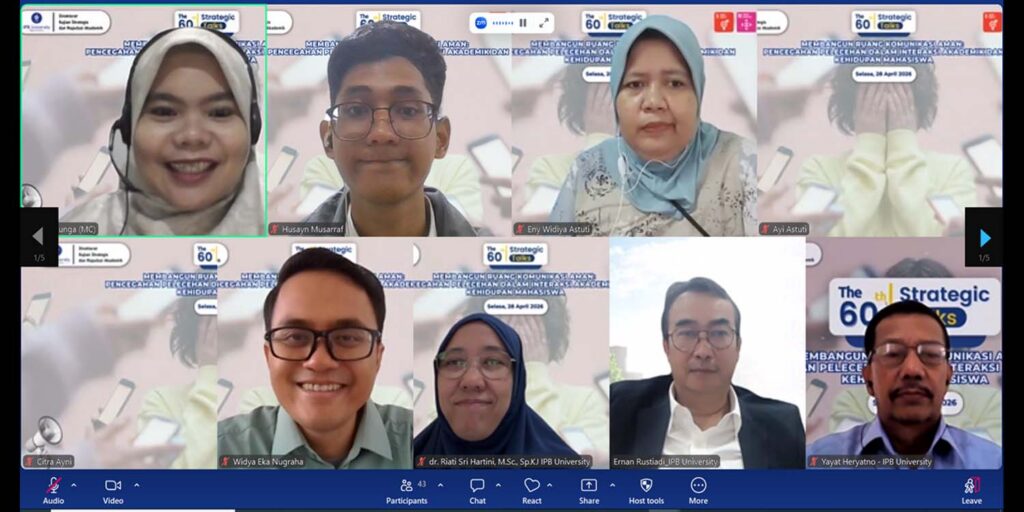
Higher education institutions bear a critical responsibility for creating a safe, inclusive academic environment free from all forms of violence. This issue was the central focus of the 60th IPB Strategic Talk titled “Building Safe Communication Spaces: Preventing Harassment in Academic Interactions and Student Life.”
The event, organized by the Directorate of Strategic Studies and Academic Reputation (DKSRA) at IPB University, discussed the prevention of harassment, the psychological impact on victims, strengthening reporting systems, and the importance of building safe communication spaces within the university environment.
In his opening remarks, the Vice Rector for Research, Innovation, and Agromaritime Development at IPB University, Prof Ernan Rustiadi, emphasized that women are one of the groups most vulnerable to harassment. Therefore, the campus must have clear, safe, and victim centered prevention and response systems. “The campus must be a safe space for students. IPB University is committed to always standing by the victims,” he stated firmly.
One of the speakers, dr Riati Sri Hartini, SpKJ, MSc, a lecturer at the Faculty of Medicine and Nutrition (FKG) at IPB University, cited 2021 data from the World Health Organization (WHO) in her presentation, revealing that 1 in 17 women has experienced sexual violence. Nevertheless, many cases go unreported because victims face stigma, fear, social pressure, and concerns about not being believed.
As a psychiatrist, she also highlighted the impact of sexual abuse on the victim’s mental health. Experiences of abuse can trigger long term trauma, including post-traumatic stress disorder (PTSD). “This trauma can affect brain function, particularly the amygdala and hippocampus, which are involved in emotion regulation, memory, and decision making,” she explained.
The consequences, she continued, can manifest as withdrawal, reduced self confidence, social relationship difficulties, trouble concentrating, and impaired academic performance. Therefore, dr Riyati emphasized, “Victims need to be listened to without judgment, have their feelings validated, and be directed to professional help if necessary.”
Meanwhile, Puji Mudiana, SP, MA, a member of the IPB University Task Force for the Prevention and Handling of Sexual Violence (Satgas PPKS), outlined the institution’s commitment to creating a safe space for all members of the IPB community. She noted that IPB University established the Satgas PPKS in 2021 as part of its campus wide system for preventing and addressing sexual violence.
“As a preventive measure, IPB University continues to strengthen education through student orientation, outreach to faculty and staff, internal training for the task force team, and the development of a reporting system that is safe, fast, easily accessible, and protects the victim’s confidentiality,” she explained. She also encouraged reporting through official channels to protect the victim’s identity and prevent revictimization.
On that occasion, the Director of Youth Resilience Development at the Ministry of Population and Family Development/BKKBN (Kemendukbangga), Dr Edi Setiawan, emphasized the role of the Student Information and Counseling Center (PIK-M) as a peer support platform through the peer educator and peer counselor approaches.
“The role of peers has become even more crucial because their influence is actually greater than that of parents and teachers. The presence of PIK-M is expected to serve as a safe initial space for students to consult, seek information, and receive support when facing personal issues or violence,” he said.
Through this forum, IPB University reaffirmed that preventing harassment in the university environment requires more than just regulations; it must be built through cultural change, education, and systems that prioritize victims. (*/Rz) (IAAS/LAN)
