

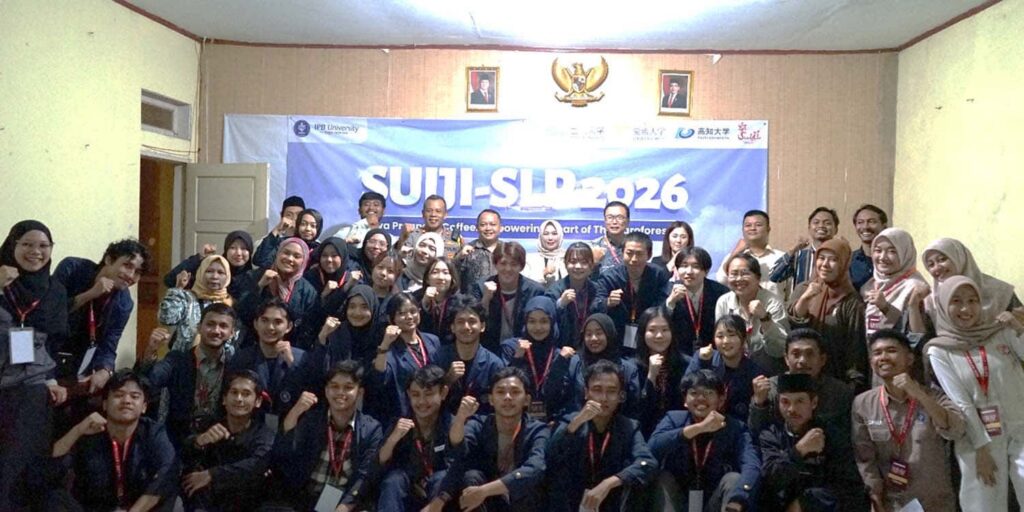
A total of 28 students, consisting of 21 students from IPB University and 7 Japanese students (Ehime University, Kochi University, and Kagawa University), along with two Japanese professors and three IPB lecturers, participated in a series of community service activities in the agroforestry area of Garut.
This area is managed by the Al Bayyinah Cooperative and is supervised by Dr Handian Purwawangsa, a lecturer at the Faculty of Forestry and Environment and the Chairman of the Institute for Agromaritime Development and Innopreneurship Acceleration (LP2AI) at IPB University.
Participants traveled eight hours from Bogor to Jayamekar Village, Pakenjeng District, Garut Regency, West Java, to carry out community service activities through the Six University Initiative Japan-Indonesia (SUIJI) Service Learning Program (SLP).
The students were received at the Jayamekar Village Office by the Chief of Pakenjeng District, the Chief of Jayamekar Village, the Pakenjeng Sector Police Chief, district staff, and the local community on Saturday (2/22).
In his remarks, the Chief of Pakenjeng District stated, “This activity not only strengthens collaboration between students and the community but also serves as an initial step in building experiential based learning that contributes to the sustainable development of the village’s potential.”
Meanwhile, the Chief of Jayamekar Village, Lia Suzana, warmly welcomed the students. “We feel proud and are open to collaboration. It is hoped that the presence of SUIJI-SLP students can provide a positive impact on economic strengthening and community empowerment in the village,” she remarked.
Dr Supriyanto, as the Assistant for Agromaritime Services at LP2AI, added, “This SUIJI Indonesia-Japan activity is a platform to introduce agroforestry products such as coffee, durian, and avocado to Indonesian and Japanese students.”
Indri Hapsari Fitriyani, Assistant Director of International Education Planning and Development, accompanied the students and formally handed over the SUIJI Indonesia-Japan implementation team.
“Students do not only learn from theory but interact directly with the community and observe real agroforestry practices in the field. This becomes a highly valuable collaborative learning space,” she said.
The first day’s activities also included visits to various agroforestry business sites. Students observed firsthand the processes of tea leaf picking, sorting, withering, rolling, and drying. They were also invited to observe the agroforestry area and practice avocado grafting, cardamom drying, and the downstream processing of coffee.
The community service activities will continue until March 1st, 2026, featuring various programs such as introducing coffee agroforestry from upstream to downstream, environmental education for schools around the village, and various innovations alongside the community. This activity is organized by the Directorate of International Education (DPI) and the Institute for Agromaritime Development and Innopreneurship Acceleration (LP2AI).
Through a service-learning approach, students are expected to be able to explore local potential while formulating real, sustainable contributions for Jayamekar Village.
