

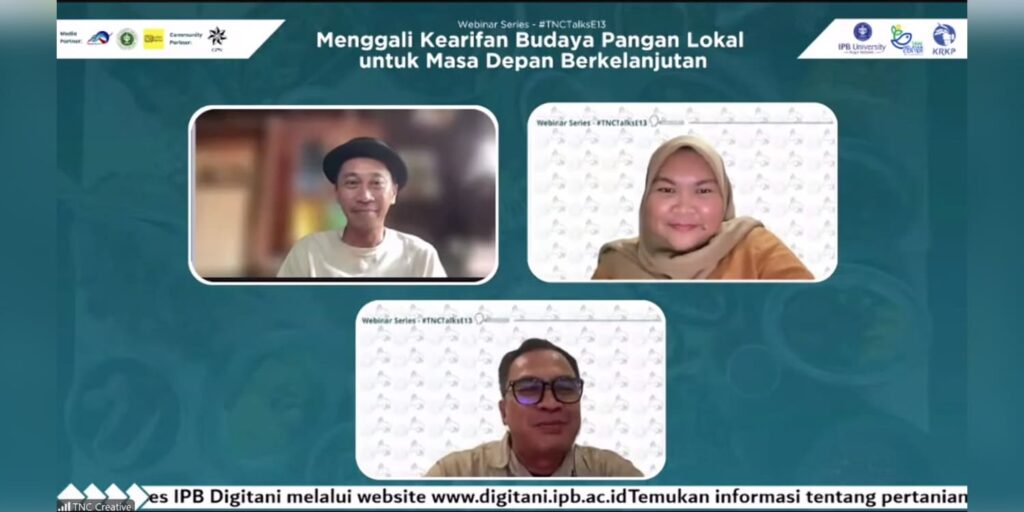
In commemoration of World Food Day, the Tani Nelayan Center (TNC) held a web series #TNCTalks featuring various speakers to explore the wisdom of local food culture.
The event was opened by Vice Rector for Research, Innovation, and Agromaritime Development Prof Ernan Rustiadi and The Director of TNC IPB University Prof Hermanu Triwidodo, and was attended by 327 participants via Zoom and YouTube (10/16).
In his speech, Prof Hermanu emphasized that food must be understood from a cultural perspective, not merely as a source of calories. According to him, food is part of the identity of the archipelago, which is now becoming increasingly homogeneous due to modernization. He hoped that this discussion would remind us of the importance of food diversity in achieving national food sovereignty and security.
Prof Ernan added that since the Green Revolution, technology has indeed succeeded in disproving Thomas Malthus’ prediction of a “catastrophe” (a sudden major disaster) due to food shortages. However, this progress has created new problems, such as dependence on a single production system and a decline in biodiversity.
“Some believe that the key to food security lies in our own food diversity,” he said.
The discussion was then continued by Said Abdullah, a researcher and food sovereignty activist. He highlighted that eating is not just a physical activity, but a spiritual relationship between humans and the Creator.
“We often forget who grows and processes our food,” said the Coordinator of the People’s Coalition for Food Sovereignty.
He also quoted the philosophy of the Slow Food movement: “Eating is an agricultural act. Choosing local food means choosing the future.” According to him, true independence begins when humans are able to eat from their own land.
Meanwhile, JJ Rizal discussed how food politics has been the foundation of the nation’s struggle since colonial times. He explained that hunger during the Dutch East Indies era sparked national awareness to fight for food sovereignty.
“The safety of the nation lies in local kitchens. As long as the kitchens are smoking, this nation is still great,” he said. Rizal believes that the kitchen is not just a place for cooking, but a symbol of the strength of civilization that sustains the life of the nation.
From a cultural perspective, Wilda Yanti Salam highlighted the philosophy of the kitchen in Bugis society, known as “Makkalu Dapureng” or the process of attaching the kitchen.
“This philosophy shows that the kitchen is the center of a family, so when someone moves, the most important thing is that they move their kitchen,” she explained.
She also highlighted the younger generation, who are now beginning to lose their connection with the cooking process and the social values behind food.
Rizal closed his presentation with a reflective message. “We live looking forward, but understand looking back. Return to the kitchen of every home, because that is where the future of the nation is cooked, then start from your tongue, to continue to make your kitchen synergistic and steaming.” (Ez) (IAAS/FMT)
