

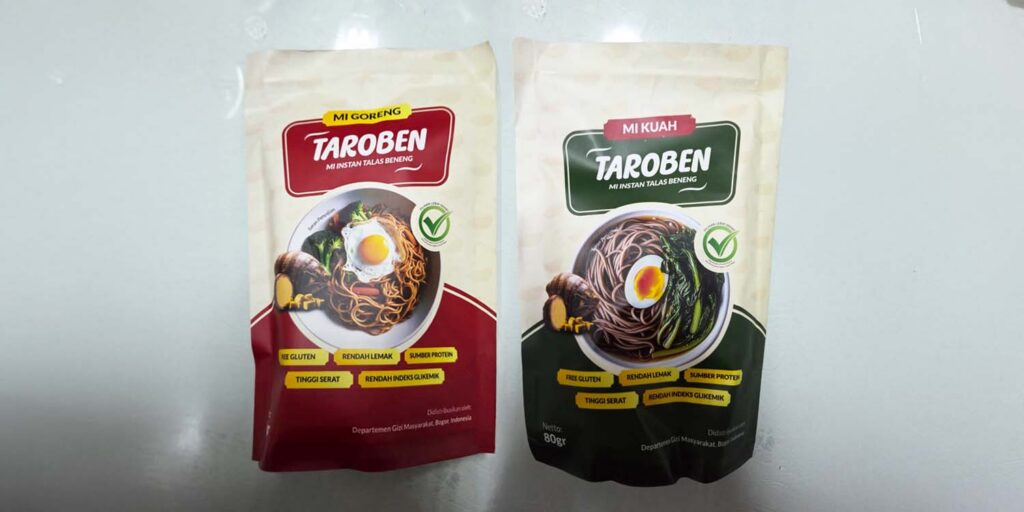
Efforts to provide healthy food while supporting national food security have driven the birth of various innovations based on local resources. One such innovation is Mi Taroben, a low-glycemic, gluten-free noodle developed by IPB University innovator, Prof Ahmad Sulaiman.
This innovation, recently selected for the 117 Indonesian Innovations 2025 list by the Business Innovation Center (BIC), utilizes Beneng taro as its primary raw material. Until now, Beneng taro has held great potential but remained underutilized as a daily food source.
According to Prof Ahmad Sulaiman, the initial idea for developing Mi Taroben arose from concerns regarding public consumption patterns and national food security.
“The government’s efforts to increase food diversification served as the background for this innovation. While rice consumption has begun to decline, the consumption of wheat based noodles is actually increasing,” he stated.
He explained that the dependence on wheat is a serious concern because the raw material is entirely imported. This condition poses a potential risk to food security, especially during global crises.
“High dependence on imported wheat can certainly threaten national food security. In reality, Indonesia possesses many potential local food sources,” he explained.
One local food source considered to have distinct advantages is beneng taro, a plant native to Pandeglang, Banten. This plant offers high productivity as well as several agronomic and nutritional benefits.
“Thus far, Beneng taro has mostly been utilized for its leaves, which are exported as an alternative tobacco raw material. However, the tubers have great potential as a food source,” said Prof Ahmad.
He added that nutritionally, Beneng taro has a high starch content, fiber, and prebiotics that are beneficial for digestive health. Furthermore, this ingredient is gluten-free and possesses a low glycemic index.
“These advantages make Beneng taro highly potential for processing into functional food, including healthy noodles,” he clarified.
Compared to commonly consumed wheat noodles, Mi Taroben offers several health benefits. The product contains complex carbohydrates, is high in fiber, and contains prebiotics beneficial for gut microbiota.
“Mi Taroben also has a low glycemic index, making it safer for people with diabetes or those looking to manage their weight,” he said.
Nevertheless, the development process for Beneng taro-based noodles was not without its challenges. According to Prof Ahmad, the greatest hurdle lay in the formulation process to ensure the dough had the right characteristics to be processed into noodles.
“The main challenge was how to create a dough with functional properties such as good plasticity, appropriate cooking time, and sufficient protein content so that the texture resembles conventional noodles,” he explained.
Through this innovation, Prof Ahmad hopes that the utilization of Beneng taro will continue to grow and encourage the creation of various healthy food products based on local ingredients.
“Local food innovations like this are expected not only to improve the nutritional quality of the community but also to strengthen national food security,” he concluded. (IAAS/HNF)
