

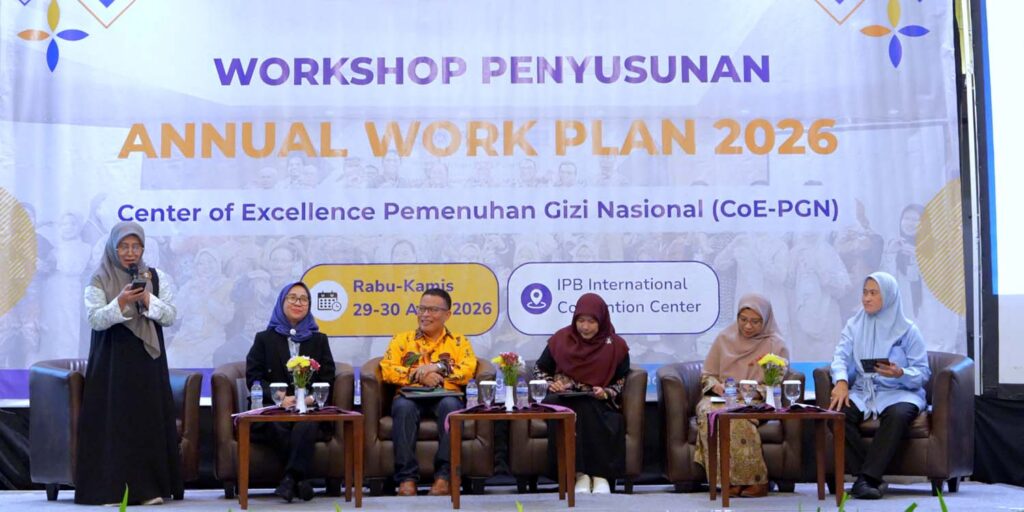
IPB University, together with the National Nutrition Agency, the Ministry of National Development Planning/National Development Planning Agency (Ministry of PPN/Bappenas), and the United Nations Children’s Fund (Unicef), is developing the 2026 Annual Work Plan (AWP) for the Center of Excellence for Food and Nutrition Security (CoE PGN). The event took place over two days (4/ 29–30) 2026 at the IPB International Convention Center.
IPB University Rector Dr Alim Setiawan emphasized that the development of this work plan is a strategic step to address the complexities of the Free Nutritious Meals (MBG) program, ranging from the availability of nutritious food to equitable access and program sustainability. He noted that the CoE, established through national policy, plays a role in ensuring the program runs effectively, measurably, and with tangible impact.
“The MBG program faces significant challenges. Therefore, through this CoE, we aim to ensure the program operates effectively and delivers direct benefits to the community,” he stated.
The Chairperson of the IPB International Research Institute for Food, Nutrition, Health, and Halal, Prof Erika B. Laconi, stated that throughout 2025, the CoE has produced various studies, innovations, and training modules that will be integrated into the digital learning system. Its scope spans seven regions, including training and the development of educational materials.
Additionally, IPB University, in collaboration with Unicef, has conducted a baseline study in Jayapura to determine more targeted program interventions. Various international collaborations have also been carried out, including sanitation surveys with partners from Japan and New Zealand, as a foundation for strengthening the MBG program.
IPB has also prepared 419 training personnel, consisting of 77 national trainers and 342 educational facilitators, to support program implementation in the field.
During the forum, stakeholders emphasized the importance of ensuring that the guidelines developed can be effectively implemented. Cross sectoral collaboration is expected to transform the MBG program into a system that not only improves the community’s nutritional status but also fosters character education and builds an adaptive ecosystem tailored to the local context.
Meanwhile, Director of Public Health and Nutrition Diah Lenggogeni, ST, MS, highlighted four key focuses for strengthening the CoE’s role: improving the quality of the MBG program through nutrition standards and food safety, strengthening education, developing policy recommendations, and disseminating best practices.
The CoE also plays a role in integrating MBG program pilot projects across various regions. Pilot projects are being conducted with a focus on strengthening the food supply chain, developing the ecosystem, implementing the blue food concept, food safety systems, and improving program business processes. The pilot projects are planned to be carried out in several regions, such as Malang, Papua, East Nusa Tenggara, and Southeast Sulawesi. (dh)(IAAS/PRO)
