

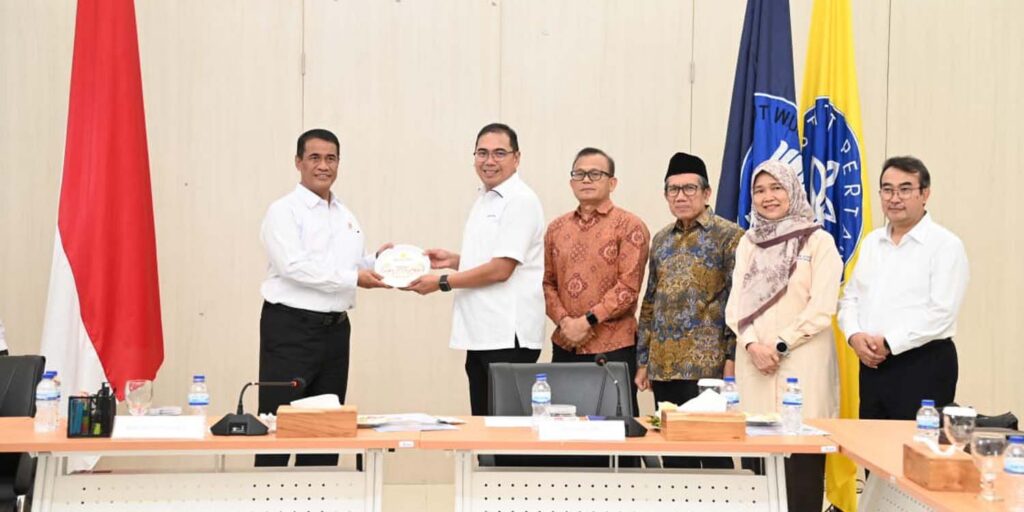
Several IPB University leaders held a meeting with the Indonesian Minister of Agriculture under the theme “Co-Creating Indonesia’s Food Transformation and Resilience” at the Startup Center Building, IPB Taman Kencana Campus, Bogor (4/9). This event served as a strategic collaboration platform between academia and the government to accelerate innovation in the national agricultural sector.
Minister of Agriculture Dr Amran Sulaiman commended IPB University’s contributions in producing innovations that have a tangible impact on increasing national food production. He highlighted the success of IPB’s high-yielding rice varieties, particularly IPB9G, which can significantly boost productivity.
“This collaboration has been ongoing for a long time. One of the standout aspects is IPB’s rice seeds, which can achieve yields of 9 to 11 tons per hectare far exceeding the national average of around 5,5 to 6 tons. This is extraordinary,” he said.
As a tangible form of support, the Ministry of Agriculture has purchased IPB9G products worth up to Rp250 billion. According to him, this step is a form of recognition for the researchers who have contributed to national food security.
“We want research results not to stop at the laboratory, but to be directly implemented on a large scale so that the benefits can be felt by the community,” he emphasized.
In addition to rice, the Minister of Agriculture is also promoting the development of other strategic commodities such as garlic, cassava (tapioca), and coffee. He emphasized the importance of innovation in overcoming various production challenges, including shortening the dormancy period of garlic to boost national productivity.
“We are no longer talking about pilot scale projects, we have already moved to an industrial scale. Everyone must act quickly to address future food challenges,” he added.
Meanwhile, Rector Dr Alim Setiawan Slamet affirmed IPB University’s readiness to support agricultural transformation through strengthened research, innovation, and human resources. He noted that a co-creation approach is key to aligning government needs with academic capabilities.
“We are building this collaboration through a co-creation model, where IPB and the Ministry of Agriculture jointly discuss issues, solutions, and the implementation of innovations to ensure they are effective and have a broad impact,” he explained.
He noted that various innovations from IPB University have begun to be widely adopted, including high-yielding rice varieties that contribute to increased national rice production. Demand for seed production has also continued to rise significantly.
“Last year it was around 4.000 tons, and this year we’re targeted to reach 12.500 tons and even asked to produce more. This demonstrates significant trust in IPB’s innovations,” he said.
In addition, he continued, IPB University is also developing innovations in the livestock sector, such as high yield, fast growing chickens, and promoting the commercialization of innovations through startups developed by students and alumni.
Not only that, the collaboration has also been expanded to include the development of plantation commodities through the concept of social forestry. IPB University, together with the Ministry of Agriculture, will cultivate approximately 1,7 million coffee seedlings across 1.700 hectares of land, as well as other commodities such as durian and avocado.
“We received a lot of input from the Minister, so that the direction of future research will be more targeted and able to address the needs of the community,” he added.
Through this collaboration, IPB University reaffirms its role as a strategic partner of the government in strengthening national food transformation and resilience amid increasingly complex global challenges. (AS) (IAAS/SSR)
