

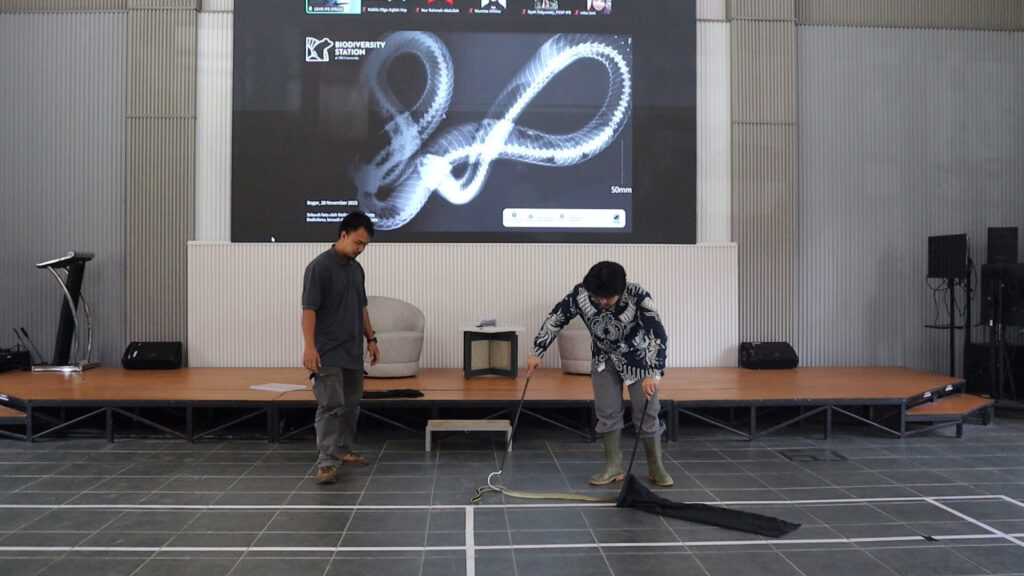
Herpetofauna expert and Executive Director of the Indonesia Herpetofauna Foundation, Nathan Rusli, delivered an educational session on handling snake human conflicts at IPB University, Bogor, on Friday (4/25).
The activity was organized through a collaboration between the School of Veterinary Medicine and Biomedical Sciences (SKHB) and the Campus Security, Safety, and Protection Management Office (KMKKPK) of IPB University. It was attended by lecturers, education staff, and students enrolled in Occupational Health and Safety (K3) courses.
In his presentation, Nathan explained that fear of snakes is often a form of “perceived risk,” meaning an exaggerated fear that is not always proportional to the actual threat. However, he emphasized the importance of understanding real risks to respond appropriately when encountering snakes.
He categorized snakes into three main groups. First, non venomous snakes, which pose low risk and are incapable of causing serious injury or death. Second, large constrictor snakes over two meters in length, which pose moderate risk due to their ability to coil around prey. Third, venomous snakes, which pose high risk due to their ability to immobilize or kill through bites.
According to Nathan, most snakebite cases occur because snakes feel threatened or due to careless human behavior. He cited the king cobra as an example of a generally shy species that will only attack when disturbed. “Most incidents are purely accidental or occur when humans attempt to catch or play with snakes,” he said.
He also highlighted snakes’ adaptive abilities in nature, such as ground dwelling species that mimic leaf patterns for camouflage. This often causes humans to overlook their presence, leading to unintended encounters.
To reduce risk, Nathan recommended simple precautions such as wearing boots or thick footwear, using flashlights in dark areas, and avoiding placing hands into bushes or holes without checking conditions first. He stressed that people should not attempt to catch or kill snakes without proper expertise and equipment.
Nathan also pointed out the limited availability of medical facilities for treating snake envenomation in Indonesia, making prevention the most crucial step. “If you are unsure about the type of snake, do not touch it,” he advised.
Regarding first aid for snakebite victims, he warned against incorrect practices such as cutting the wound, sucking out venom, or tying the affected area.
“Snake venom does not immediately enter the bloodstream but spreads through the lymphatic system. Actions like cutting and tying can worsen the condition,” he explained. He advised minimizing movement of the affected limb and seeking immediate medical assistance.
This activity is expected to enhance awareness among the academic community of IPB University regarding risks and safe responses to snake encounters on campus. (IAAS/CAA)
