

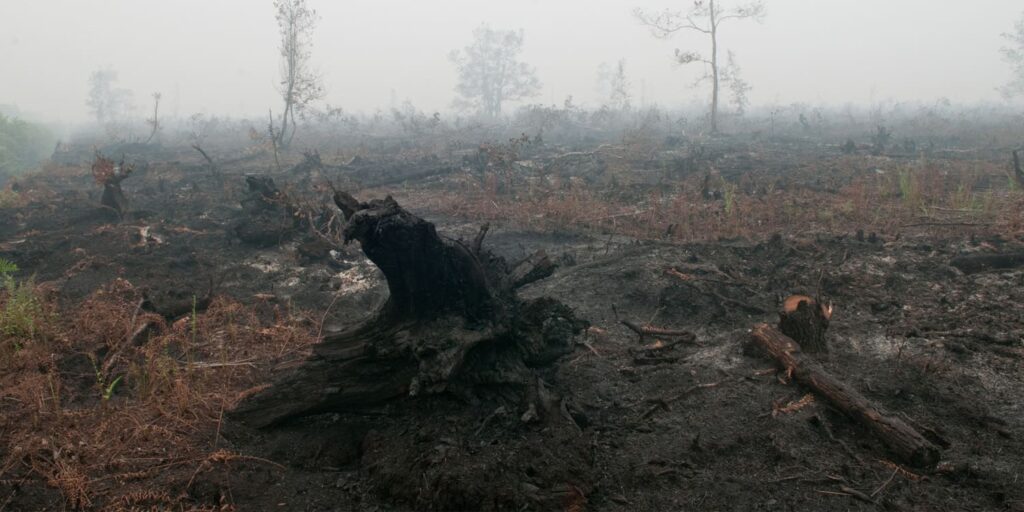
IPB University once again presents a solution for peatland fire mitigation through an ecohydrology approach. Professor Muh Taufik, a professor at the Faculty of Mathematics and Natural Sciences (FMIPA), has developed an early fire detection system based on the Peat Fire Vulnerability Index (PFVI) that can predict vulnerability up to 14 days in advance.
Prof Taufik explained that the PFVI system has been implemented in priority peat restoration areas since 2021 through collaboration with the Peat and Mangrove Restoration Agency (BRGM).
“This has been applied at BRG since 2021 and BRGM until 2024 in six main provinces, namely Riau, Jambi, South Sumatra, South Kalimantan, Central Kalimantan, and West Kalimantan,” he explained during the IPB University Professor Scientific Oration Open Session (10/25) at the Dramaga Campus.
However, he highlighted that there are still obstacles in utilizing the 14-day “window of opportunity” for early mitigation. “Fire-prone locations can actually be identified earlier. But regional funds can only be used after a disaster occurs, not for anticipation. That is the main problem we face,” he said.
According to Prof Taufik, Indonesia’s peatland area spans 14 million hectares with carbon reserves of up to 50 gigatons, nearly half of the world’s total tropical peatland carbon reserves.
The massive transformation since the 1990s into agricultural and plantation land has disrupted hydrological functions and made the land prone to fires. “A decrease in the water table (TMAT) below 60 cm significantly increases the potential for fires,” he said.
Through an ecohydrology approach, the balance between ecology and hydrology is maintained so that peatlands remain wet, emissions are low, and biodiversity is preserved. “This approach offers the principle of dual regulation between natural regulation and human activity,” he said.
In his research, Prof Taufik developed the PFVI model with three main variables: rainfall, air temperature, and TMAT. Its integration with Weather Research and Forecasting (WRF) enables predictions of conditions up to two weeks in advance.
In addition, he and his team created the RAMIN (R-based Assessment for Modeling Indonesian Nature) platform, an online system that combines hydrological modeling, carbon emissions, and carbon credit valuation. “RAMIN uses local data in real time, transparently, and based on scientific research,” he explained.
Prof Taufik emphasized that ecohydrological-based peatland management not only reduces the risk of fire but also supports the national green economy agenda. “If peatland conditions are maintained, we can reduce greenhouse gas emissions and support the government’s NDC (Nationally Determined Contribution) targets,” he said.
The ecohydrology approach is also considered capable of integrating science with public policy. According to Prof Taufik, scientific data-based decision making can strengthen environmental governance that is adaptive to climate change.
He hopes that the results of this research and innovation will be a real contribution from IPB University in strengthening the resilience of Indonesia’s peat ecosystems and maintaining a sustainable balance between nature and the economy. (Fj) (IAAS/LAN)
