

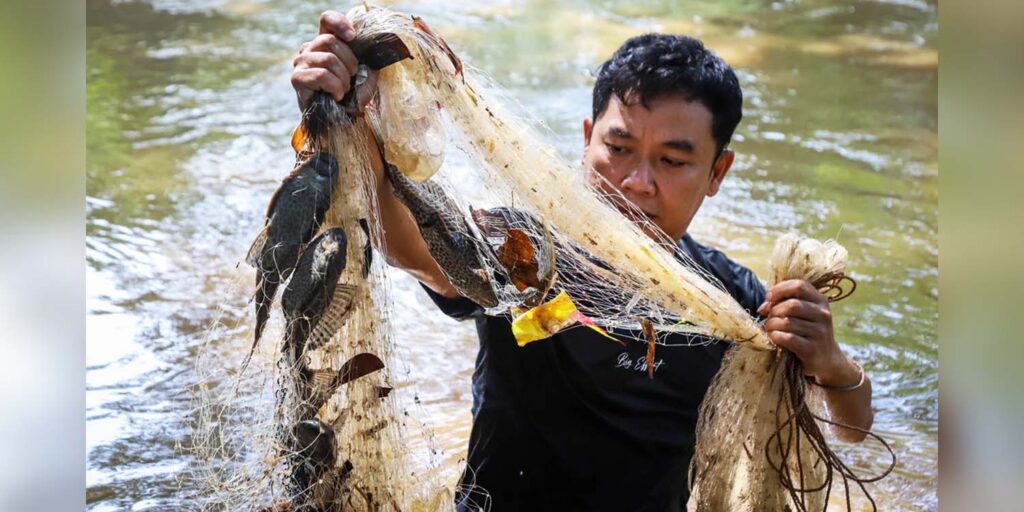
The population explosion of suckermouth catfish in Jakarta’s rivers is becoming increasingly alarming. Amid plans by the Jakarta Provincial Government (Pemprov DKI Jakarta) to expand mass capture operations, an IPB University expert cautions that this approach alone is not sufficiently effective.
Dr Charles PH Simanjuntak, an expert in fish and fish conservation at the Faculty of Fisheries and Marine Sciences at IPB University, emphasized that controlling the suckermouth catfish population must be done in an integrated manner. “The most effective approach is to combine several methods in an integrated manner from prevention, capture, to biological control,” he explained.
The suckermouth catfish (Pterygoplichthys pardalis) is an introduced non-native species known as an invasive species with extremely high reproductive capacity. In a single cycle, a female can produce up to 19.000 eggs and can reproduce several times a year.
“A single male fish can fertilize two female fish. The male will guard the eggs in the burrows they dig until they hatch, resulting in a survival rate of over 90 percent,” he explained.
Not only that, but this fish is capable of reproducing at a young size (23,9–28,99 cm for males and 13,0–25,98 cm for females), thereby accelerating the invasion cycle.
This fish is also omnivorous and has a high adaptability to various food sources. In its native habitat in the Amazon River, South America, the natural predators of the suckermouth catfish include the Common Snook (Centropomus undecimalis), the Tarpon (Megalops atlanticus), the Spectacled Caiman (Caiman crocodilus), and the Neotropic Cormorant (Phalacrocorax brasilianus).
“The absence of specific predators in ecosystems like the Ciliwung River is the main reason why this fish is so difficult to control,” he explained.
A Combination of Three Strategies
To that end, he emphasized the importance of a combination of control measures: prevention, physical removal, and biological control. Regarding prevention, Dr Charles suggested, “The Jakarta Provincial Government needs to strengthen regulations on the trade of ornamental fish and raise public awareness to prevent the release of suckermouth catfish into natural water bodies, whether intentional or not.”
Additionally, early monitoring technologies such as environmental DNA (eDNA) are considered effective for detecting the presence of the fish early on before their population explodes.
In situations where the population is already high, capture remains necessary but must be more selective and targeted. According to him, capturing small fish (less than 30 cm) can be more effective in suppressing the population.
Community involvement is also key. Community-based fishing is considered capable of controlling populations on a local scale, although long-term success may be limited by immigration (the influx of suckermouth catfish) from other areas. “Therefore, it must be carried out systematically along the river’s course. suckermouth catfish that have been caught also need to be destroyed to reduce their numbers,” he explained.
From a biological control perspective, utilizing natural predators such as baung and betutu fish can help control the population, although this is only effective during the juvenile stage of suckermouth catfish, which measure 0,6–1,0 cm.
He also proposed efforts to utilize suckermouth catfish to reduce the population. However, not for consumption. “It is not recommended if they come from polluted waters that may contain heavy metals, so they are not recommended for consumption,” he emphasized.
With an integrated approach involving various stakeholders, sapu-sapu control is expected to be carried out more effectively and sustainably, while maintaining the balance of Jakarta’s aquatic ecosystems. (dh)(IAAS/PRO)
