

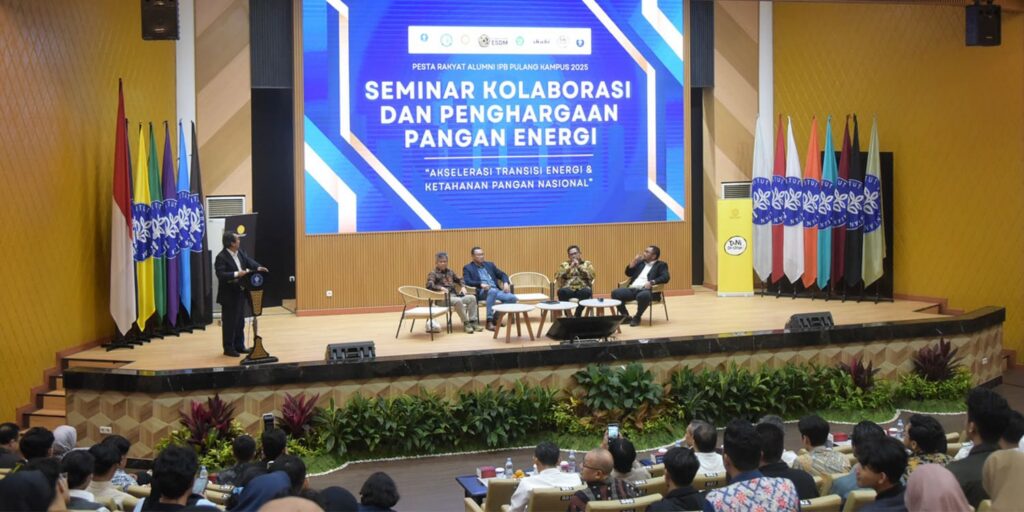
Food security and energy transition are often seen as two major agendas that are at odds with each other. However, cross institutional collaboration shows that both can be accelerated simultaneously through integrated research, innovation, and policies.
This commitment was confirmed through the signing of a Memorandum of Understanding (MoU) on the Commitment to Accelerate National Energy Transition and Food Security by six strategic elements, namely IPB University, the Directorate General of New Renewable Energy and Energy Conservation of the Ministry of Energy and Mineral Resources, the National Research and Innovation Agency (BRIN), the IPB Alumni Association (HA), the Indonesian Bioenergy Experts Association, and the Secretariat General of the National Energy Council.
The signing took place at the Andi Hakim Nasoetion Auditorium, IPB Dramaga Campus, Bogor, on Wednesday (12/18) during the Food and Energy Collaboration and Awards Seminar as part of the IPB Alumni Homecoming Festival (PRA IPK) 2025.
IPB University Vice Rector for Research, Innovation, and Agromaritime Development, Prof Ernan Rustiadi, emphasized that the issues of food, energy, and the environment should not be pitted against each other because they have many points of convergence that can be integrated.
“IPB University contributes through various research projects, ranging from algae-based biodiesel, macroalgae biogas, bioethanol, to food innovations such as healthy seaweed rice, artificial rice, superior sorghum, and ready to eat food products,” he said.
From the perspective of national research, the Chairman of the BRIN Fuel Technology Research Center, Dr Hari Satya Praja, said that Indonesia has great geographical and biodiversity potential to lead multilateral research and innovation cooperation in the energy and food sectors.
According to him, BRIN’s strategy is directed through strengthening innovation research, supporting research infrastructure and human resources (HR), and transferring advanced technology from the early stages of research.
Meanwhile, Chairman of the Indonesian Bioenergy Experts Association, Dr Cahyo Setyo Wibowo, emphasized that bioenergy development must go hand in hand with food security. He highlighted the successful implementation of B30 and B40 biodiesel, biomass development, and plant-based fuels, which still need to be managed sustainably.
The Director of Bioenergy at the Ministry of Energy and Mineral Resources, Ir Edi Wibowo, MT, called this forum an important moment to respond to national challenges, including climate change mitigation and the 2060 net zero emissions target.
The Rector of IPB University, Dr Alim Setiawan Slamet, emphasized that this event is not merely a gathering for alumni, but rather a consolidation of ideas and concrete actions.
“IPB University is committed to promoting research and collaboration so that innovations in food and energy can be directly utilized by the community,” he said.
HA IPB Chairman, Dr Walneg S. Jas, added that the 2025 IPB Alumni Homecoming Festival includes 103 series of activities and 25 strategic agendas, with multi-party collaboration as the key to addressing major national challenges.
This collaboration reinforces IPB University’s position as an important hub for research and innovation in strengthening a sustainable national food and energy system. (dh) (IAAS/NRA)
