

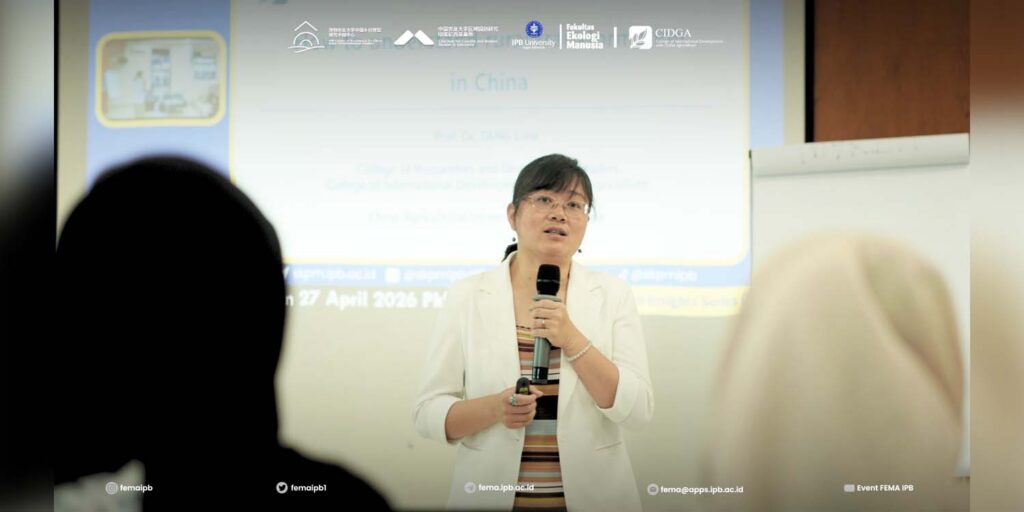
The Faculty of Human Ecology (FEMA) at IPB University recently hosted the “IPB–CAU Rural Transformation Insights Series Vol 1” at the IPB Dramaga Campus. Focusing on the topic of rural transformation in China, this event served as an academic forum to deepen understanding of the dynamics of rural development and transformation based on China’s experiences.
The Dean of Fema IPB University, Prof Sofyan Sjaf, explained that this event is a form of collaboration between IPB University and China Agricultural University (CAU). Similar events will continue to be held on the topic of rural transformation in China.
“Together with CAU, we are conducting joint research on rural transformation that compares villages in these two countries. The aim is to learn from one another to alleviate poverty, inequality, and unemployment, as well as to strengthen the southern regions,” explained Prof Sofyan.
This IPB University professor in the field of rural development sociology revealed why rural transformation in China became the main topic of the event. Prof Sofyan noted that China has so far succeeded in eradicating poverty, preventing inequality and unemployment, and mobilizing the youth through the village level.
“This example is compelling for countries in the Global South. It also aligns with the agenda of Indonesia and IPB University to strengthen the Global South,” stated the initiator of the Precision Village Data (DDP) initiative.
The event featured Prof Tang Lixia from the College of Humanities and Development Studies at China Agricultural University. Prof Tang Lixia is known for her teaching expertise in public policy analysis, rural development policy, international development aid, and comparative governance and politics. Her research interests include poverty reduction and social policy, China-Africa Cooperation, and international development aid.
In her presentation, Prof Tang Lixia explained that rural transformation in China cannot be understood merely as physical changes in villages, but as a long-term process encompassing shifts in policy, rural urban relations, farmers’ income structures, agricultural production systems, as well as new functions and values of rural areas.
“Rural transformation in China has evolved through several key stages, ranging from the household responsibility system, industrialization and urbanization, rural infrastructure development, to the rural revitalization strategy emphasizing five aspects of revitalization: agriculture based business, ecology, culture, and rural governance,” said Prof Tang Lixia.
Prof Tang Lixia emphasized that China’s rural urban relationship has now moved beyond a dualistic structure. Farmers’ livelihoods are shifting toward non-agricultural sectors with rising incomes. Additionally, agricultural production is becoming increasingly mechanized and moving from small scale farming toward medium scale operations, while the functions of rural areas are becoming more diverse.
The IPB–CAU Rural Transformation Insights Series Vol 1 event strengthens cross-national academic exchange on rural transformation as a development strategy for poverty alleviation and improving community well being.
As a follow up, the Faculty of Ecology (Fema) at IPB University established the IPB-China Agricultural and Rural Transformation Studies (IPB-CHART) to sustainably organize the outcomes of this strategic collaboration. (AMA/MHT) (IAAS/PRO)
