

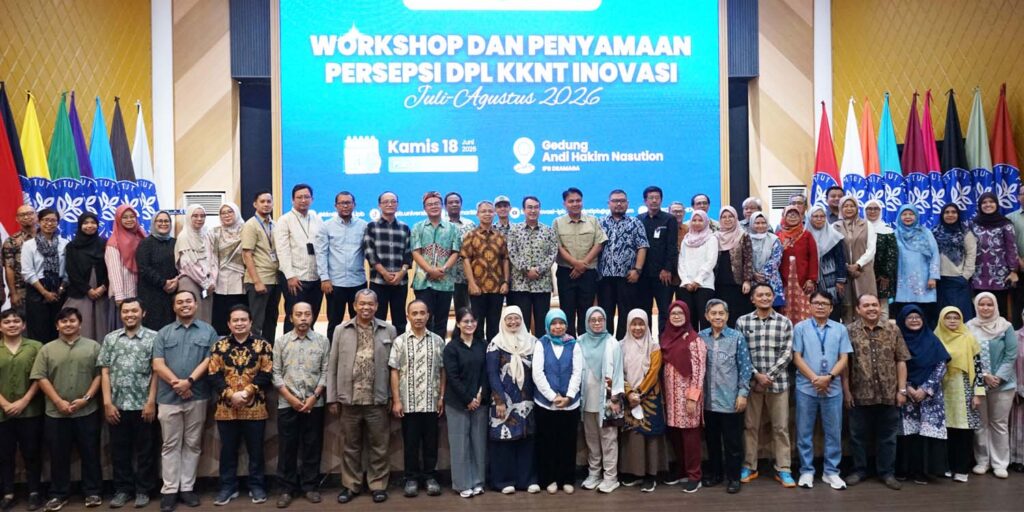
A number of IPB University’s Thematic Community Service (KKNT) Innovation programs have begun to attract the attention of other universities looking to adopt them, as they are considered successful in making a significant impact on the community.
This was stated by the Chairman of the Institute for Agromaritime Development and Innopreneurship Acceleration (LPA2I) at IPB University, Dr Handian Purwawangsa, during a workshop and alignment session for Field Supervisors (DPL) held recently.
“This year, the KKNT Innovation program will involve 3.679 students from 12 faculties, mentored by 214 field supervisors. Building on this success and large scale, this workshop was held to strengthen the program’s impact,” he said.
Vice Rector for Education and Student Affairs, Prof Deni Noviana, emphasized the crucial role of field supervisors in ensuring that the KKNT Innovation program can deliver tangible impacts and solutions for the community.
“KKNT is a tangible implementation of student learning within the community. Students must be able to become innovators and agents of change. Meanwhile, the DPLs play a role in ensuring that the programs carried out remain professionally oriented toward solutions, innovation, sustainability, and community empowerment,” he emphasized.
Assistant for Agromaritime Services, Ir Supriyanto, added that KKNT is not merely a platform for community service but also a means of developing students’ soft skills in solving development problems based on local potential through the One Village, One Product, One Village, One Innovation, and One Village, One Exporter approaches.
Implementation in the field will also be strengthened by the support of IPB University’s innovation ecosystem. Deputy Head of the Agromaritime Development and Science Technopark Institute, Prof Tri Prartono, introduced the Science and Technology Park (STP), the Agribusiness Technology Park (ATP), as well as programs for the downstreaming and commercialization of innovations that KKNT Innovation students can utilize.
“The outcomes of the KKNT program should also highlight the importance of key performance indicators (KPIs), ranging from publications, books, and social media to research publications,” added Prof Ernan Rustiadi, Vice Rector for Research, Innovation, and Agromaritime Development. He also encouraged strengthening collaboration with various partners and exploring opportunities for international KKNT development to expand the program’s impact to the global level.
Through this workshop, it is hoped that all DPLs will share a common understanding in mentoring students so that the implementation of the 2026 KKNT Inovasi program can produce initiatives that are more focused, collaborative, and have a tangible impact on the community. (*/Rz) (IAAS/LAN)
