

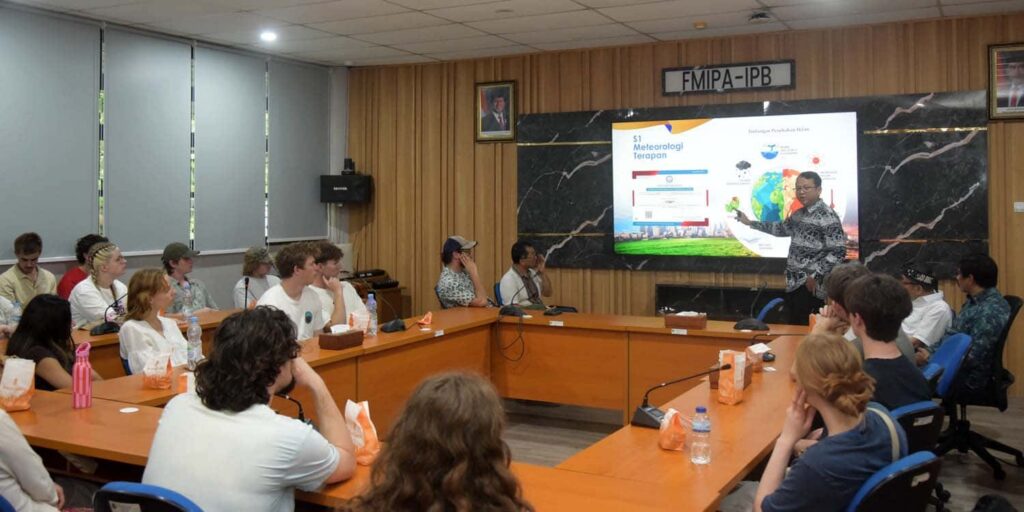
A total of 36 students from the University of Tasmania (UTAS), Australia, paid an academic visit to IPB University to take courses on sustainability. The visit focused on learning about sustainability practices in Indonesia, particularly those related to climate change and earth sciences.
The group was welcomed by the Dean of the Faculty of Mathematics and Natural Sciences (FMIPA) at IPB University, Dr. Berry Juliandi. He said that IPB University has a strong track record in the development and implementation of Sustainable Development Goals (SDGs).
“IPB University is one of the universities in Indonesia that is very concerned and prominent in sustainability issues. We have won several national awards related to SDGs. This is what attracts Australian students,” said Dr Berry.
A number of study programs were highlighted, such as Applied Meteorology, as well as marine studies relevant to climate change and marine science. “What they learn here will be officially credited for Sustainability courses in Australia,” he explained further.
Dr Taufiq Tanasaldy, a lecturer at the University of Tasmania and coordinator of the program, explained that this program is designed so that students not only understand the global context of sustainability but also build relationships between countries.
“We want students to get to know Indonesia firsthand, but with clear academic objectives. That’s why we packaged it through the Sustainability course,” he said.
He said IPB University was chosen because it has relevant flagship programs and long-standing cooperative relationships. “In the last two years, IPB has become the main location because of the strength of its programs and academic networks,” said Dr Taufiq.
Furthermore, he opened up opportunities for future cooperation, not limited to student visits. “In the future, we hope there will be reciprocity. It could be in the form of IPB students visiting Tasmania, or more effective small group research collaborations,” he said.
Regarding student exchange and double degree opportunities, Dr Taufiq assessed that IPB University has strong institutional readiness. “Collaboration will be more optimal if focused on established fields, such as marine science at UTAS or sustainability at IPB, so that the benefits are balanced,” he concluded. (AS) (IAAS/IPT)
