

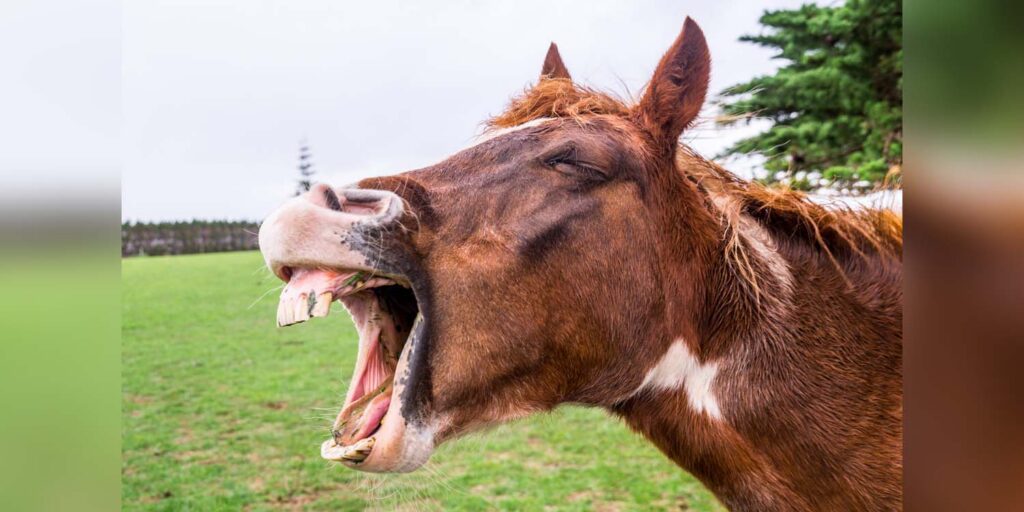
For a long time, horse behavior experts have been trying to unravel one form of horse intelligence in communication. In the wild, horses have a complex communication system. They rely not only on sound, but also on a combination of body language, facial expressions, ear movements, body posture, and vocalization (sound) to convey information and maintain harmony within the herd.
Upon closer observation, we often see horses moving their tails, changing the position of their ears, and adjusting their body posture to express emotions such as alertness, anger, and calmness. In addition, horses also change their eyes, mouth, and nose when they feel uncomfortable or threatened.
Horses often engage in physical contact, such as gentle touches and nudges, which are intended to strengthen social bonds.
Can Horses Communicate?
Of the many forms of behavior exhibited by horses, vocalization seems to attract the most attention from researchers. Neighs, snorts, and soft sounds are often emitted by horses to call, warn, or calm members of the herd.
The most fundamental question is whether horses can communicate through sound?
Researchers agree that horse sounds have evolved over time. Recent research shows that when horses neigh, they emit two sounds simultaneously: a low tone from the vocal cords and a high pitched whistle from the larynx.
This whinnying serves to signal excitement while also indicating location, thereby increasing efficiency in social communication.
This vocalization ability is rarely found in large mammals. Therefore, it is considered a special adaptation of horses to strengthen social bonds and coordination within the herd.
Recent research in the prestigious scientific journal ‘Current Biology’ shows that horses neigh as if they are singing and whistling at the same time. The ability to produce two sounds at once is known as bifocalization.
Unlike birds, which generally have two sets of vocal structures that can easily do this, mammals, including horses, have only one set of vocal cords. Therefore, the bifocalization possessed by horses is considered very rare.
Researchers from the University of Copenhagen found that horses use both low and high frequencies when neighing. The low sound is a statement that the horse is in good shape and fierce, which is a warning to other horses around it.
The high pitched sound, which is like a whistle, is produced by air being forced through a small gap, causing the surrounding air to vibrate at a certain frequency. Conversely, low pitched sounds are produced by the vocal cords, when air pushes against the tight vocal cords, causing them to open and close in waves.
The results of this research by horse behavior experts from various countries reveal that vocalization in horses is a form of communication. The high pitched sounds emitted by horses are thought to be used for long distance communication and low pitched sounds for short distances.
This is the reason why when horses are separated and gathered with other horses, they usually neigh. Horses have also been proven to be able to call other horses that are not visible.
The results of this study show that horses have the ability to express their emotions through various types of sounds with different frequencies. Low tones indicate emotions, while high tones are expressions of joy.
Horses have their own language that their keepers need to know. Vocalizations and other behavioral expressions show that horses are social creatures that feel more comfortable when in a herd and feel anxious when alone.
When keeping horses, it is important to know that horses are not animals that can be kept in stables all the time. If kept in a stall for too long, they will show anger by kicking the stall walls and expressing anxiety. Therefore, it is important for horse owners to form a strong bond with their horses. Clean your horses regularly and take them for walks in nature to keep them happy. (IAAS/LAN)
Prof Ronny Rachman Noor
Ecological Genetics Expert, IPB University
